Manuals
Safer Online Workplaces: A Toolkit for Empowering Women and Businesses
The Asia-Pacific Economic Cooperation (APEC) is a regional economic forum established in 1989 to leverage the growing interdependence of the Asia-Pacific.
The Asia-Pacific Economic Cooperation (APEC) is a regional economic forum established in 1989 to leverage the growing interdependence of the Asia-Pacific.
APEC ensures that goods, services, investment and people move easily across borders. Members facilitate this trade through faster customs procedures at borders; more favorable business climates behind the border; and aligning regulations and standards across the region.
APEC ensures that goods, services, investment and people move easily across borders. Members facilitate this trade through faster customs procedures at borders; more favorable business climates behind the border; and aligning regulations and standards across the region.
APEC has helped drive economic growth and cooperation across the Asia-Pacific by reducing trade barriers, improving the ease of doing business and strengthening connectivity among economies. These efforts have contributed to rising incomes, expanded trade and greater opportunities for businesses and communities across the region.
APEC has helped drive economic growth and cooperation across the Asia-Pacific by reducing trade barriers, improving the ease of doing business and strengthening connectivity among economies. These efforts have contributed to rising incomes, expanded trade and greater opportunities for businesses and communities across the region.
APEC brings together governments, businesses and stakeholders to collaborate on shared priorities. Explore opportunities to participate in events, contribute to initiatives and engage with APEC’s work across the region.
APEC brings together governments, businesses and stakeholders to collaborate on shared priorities. Explore opportunities to participate in events, contribute to initiatives and engage with APEC’s work across the region.
Reports
•March 2024
Download Report
471KB
Published Under
Committee on Trade and Investment (CTI), Group on Services (GOS)
Accessed
2443
Pages
42
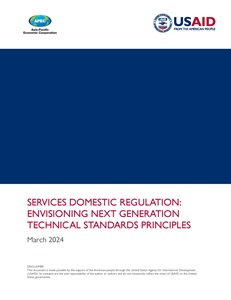
Within the subject of services domestic regulation, qualification and licensing have been subject to extensive policy analysis and discussions. However, the concept of technical standards for services has been largely underexplored. As the digital transition of services blurs the boundaries between sectors and occupations, standards can be more responsive to changes in technology and market structure than more formal regulatory instruments, making standards increasingly important for international services markets to reach their full potential. This study focuses on next generation services standards. The study presents information on the types of standards applicable to services, how standards are made, and industry views on the use and development of technical standards. The study also investigates the role of services technical standards in a rapidly changing world through case studies on (1) Building Information Modeling in architecture, engineering, and construction; (2) sound recording; and (3) artificial intelligence.