Manuals
Safer Online Workplaces: A Toolkit for Empowering Women and Businesses
The Asia-Pacific Economic Cooperation (APEC) is a regional economic forum established in 1989 to leverage the growing interdependence of the Asia-Pacific.
The Asia-Pacific Economic Cooperation (APEC) is a regional economic forum established in 1989 to leverage the growing interdependence of the Asia-Pacific.
APEC ensures that goods, services, investment and people move easily across borders. Members facilitate this trade through faster customs procedures at borders; more favorable business climates behind the border; and aligning regulations and standards across the region.
APEC ensures that goods, services, investment and people move easily across borders. Members facilitate this trade through faster customs procedures at borders; more favorable business climates behind the border; and aligning regulations and standards across the region.
APEC has helped drive economic growth and cooperation across the Asia-Pacific by reducing trade barriers, improving the ease of doing business and strengthening connectivity among economies. These efforts have contributed to rising incomes, expanded trade and greater opportunities for businesses and communities across the region.
APEC has helped drive economic growth and cooperation across the Asia-Pacific by reducing trade barriers, improving the ease of doing business and strengthening connectivity among economies. These efforts have contributed to rising incomes, expanded trade and greater opportunities for businesses and communities across the region.
APEC brings together governments, businesses and stakeholders to collaborate on shared priorities. Explore opportunities to participate in events, contribute to initiatives and engage with APEC’s work across the region.
APEC brings together governments, businesses and stakeholders to collaborate on shared priorities. Explore opportunities to participate in events, contribute to initiatives and engage with APEC’s work across the region.
Manuals
•October 2023
Download Report
863KB
Published Under
SOM Steering Committee on Economic and Technical Cooperation (SCE), Health Working Group (HWG)
Accessed
2039
Pages
41
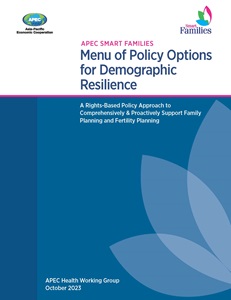
The overarching goal of APEC Smart Families is to build the capacity of health and economic policymakers to address demographic trends through the development of comprehensive, holistic policy options inclusive of both family planning and fertility planning. The intended target audience includes decision-makers or those with the ability to contribute to high-level decisions within the APEC economies, and may include governments; international organizations or civil society organizations; academia; businesses and the private sector.
The Menu of Policy Options is organized into three sections:
Within each section, the policy options are organized into an identified barrier to a healthy enabling environment, a proposed policy intervention (or in many cases, interventions), and relevant implementing entities. Where possible, the policy recommendations are also grounded in existing examples of policies from within the APEC region or other parts of the globe.