Proceedings
APEC Workshop on Higher Education in Standardization
The Asia-Pacific Economic Cooperation (APEC) is a regional economic forum established in 1989 to leverage the growing interdependence of the Asia-Pacific.
The Asia-Pacific Economic Cooperation (APEC) is a regional economic forum established in 1989 to leverage the growing interdependence of the Asia-Pacific.
APEC ensures that goods, services, investment and people move easily across borders. Members facilitate this trade through faster customs procedures at borders; more favorable business climates behind the border; and aligning regulations and standards across the region.
APEC ensures that goods, services, investment and people move easily across borders. Members facilitate this trade through faster customs procedures at borders; more favorable business climates behind the border; and aligning regulations and standards across the region.
APEC has helped drive economic growth and cooperation across the Asia-Pacific by reducing trade barriers, improving the ease of doing business and strengthening connectivity among economies. These efforts have contributed to rising incomes, expanded trade and greater opportunities for businesses and communities across the region.
APEC has helped drive economic growth and cooperation across the Asia-Pacific by reducing trade barriers, improving the ease of doing business and strengthening connectivity among economies. These efforts have contributed to rising incomes, expanded trade and greater opportunities for businesses and communities across the region.
APEC brings together governments, businesses and stakeholders to collaborate on shared priorities. Explore opportunities to participate in events, contribute to initiatives and engage with APEC’s work across the region.
APEC brings together governments, businesses and stakeholders to collaborate on shared priorities. Explore opportunities to participate in events, contribute to initiatives and engage with APEC’s work across the region.
Reports
•November 2021
Download Report
14MB
Published Under
Economic Committee (EC)
Accessed
5931
Pages
166
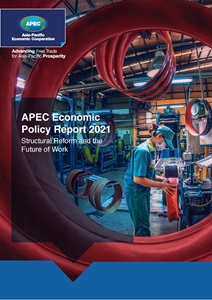
This year’s APEC Economic Policy Report discusses the complex topic of Structural Reform and the Future of Work. The four megadrivers of change discussed in the report—technological change, climate change, globalisation and demographic change—show how far our economies and societies have developed, but this development also comes with costs. The economic structures and policies that unleashed innovation, generated prosperity, and increased life expectancy have also led to growing inequality, environmental damage, and rising dependency ratios. And even as world grappled with these megadrivers, it experienced the COVID-19 pandemic in 2020, which added a layer of urgency to addressing these old challenges as new challenges emerged. The megadrivers of change will continue, but there is a need to address the real social and economic impacts that come with this change. In line with ensuring a people-centric future of work, the report makes five broad policy recommendations: (1) ensure economic security, (2) develop and redevelop skills, (3) update labour laws and institutions, (4), cooperate across borders, and (5) operationalise APEC initiatives on future of work.