Proceedings
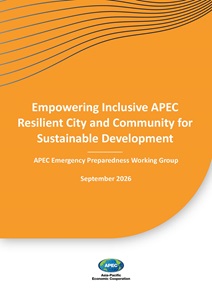
Empowering Inclusive APEC Resilient City and Community for Sustainable Development
The Asia-Pacific Economic Cooperation (APEC) is a regional economic forum established in 1989 to leverage the growing interdependence of the Asia-Pacific.
The Asia-Pacific Economic Cooperation (APEC) is a regional economic forum established in 1989 to leverage the growing interdependence of the Asia-Pacific.
APEC ensures that goods, services, investment and people move easily across borders. Members facilitate this trade through faster customs procedures at borders; more favorable business climates behind the border; and aligning regulations and standards across the region.
APEC ensures that goods, services, investment and people move easily across borders. Members facilitate this trade through faster customs procedures at borders; more favorable business climates behind the border; and aligning regulations and standards across the region.
APEC has helped drive economic growth and cooperation across the Asia-Pacific by reducing trade barriers, improving the ease of doing business and strengthening connectivity among economies. These efforts have contributed to rising incomes, expanded trade and greater opportunities for businesses and communities across the region.
APEC has helped drive economic growth and cooperation across the Asia-Pacific by reducing trade barriers, improving the ease of doing business and strengthening connectivity among economies. These efforts have contributed to rising incomes, expanded trade and greater opportunities for businesses and communities across the region.
APEC brings together governments, businesses and stakeholders to collaborate on shared priorities. Explore opportunities to participate in events, contribute to initiatives and engage with APEC’s work across the region.
APEC brings together governments, businesses and stakeholders to collaborate on shared priorities. Explore opportunities to participate in events, contribute to initiatives and engage with APEC’s work across the region.

Reports
•November 2010
Download Report
1MB
Published Under
APEC Secretariat, APEC Policy Support Unit
Accessed
51707
Pages
116
The year 2010 is a milestone for APEC, since it is the target year of Bogor Goals for the industrialized economies. In this sense, the PSU prepared this report to assist APEC members in conducting the assessment of the five APEC industrialized economies and eight APEC developing economies that volunteered to be part of this exercise.
This report concentrates on the progress achieved within the APEC region towards the Bogor Goals. In particular, the report takes a closer look on these industrialized and volunteering economies.
The report is based on publicly available data and uses a simple analytical narrative. It concludes that the participating members have indeed been “furthering reducing barriers to trade and investment since 1994”, year when the Bogor Goals came into light. APEC as a whole has moved in the same direction, too. The data also reveals that the APEC developing economies have also made good progress in their way to their target date of 2020.
In general, the results show that progress is significant across a wide array of economic, trade, investment and social measures. Also, concerted action has occurred within the APEC region and has been an important factor for this outcome. APEC economies have outperformed the rest of the world in many aspects. Nonetheless, despite this positive outcome, more efforts need to be done, since progress has been uneven across sectors. Tariffs and other non-tariff barriers still remain and resistance to reform is stronger in certain areas.
Evidence in this report indicates that the development gap is narrowing among APEC members, as part of APEC’s ultimate objectives of sustainable growth, equitable development and strengthening the Asia Pacific community.
This work is available for further use under creative commons licensing.