Manuals
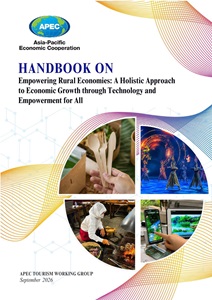
Empowering Rural Economies: A Holistic Approach to Economic Growth through Technology and Empowerment for All
The Asia-Pacific Economic Cooperation (APEC) is a regional economic forum established in 1989 to leverage the growing interdependence of the Asia-Pacific.
The Asia-Pacific Economic Cooperation (APEC) is a regional economic forum established in 1989 to leverage the growing interdependence of the Asia-Pacific.
APEC ensures that goods, services, investment and people move easily across borders. Members facilitate this trade through faster customs procedures at borders; more favorable business climates behind the border; and aligning regulations and standards across the region.
APEC ensures that goods, services, investment and people move easily across borders. Members facilitate this trade through faster customs procedures at borders; more favorable business climates behind the border; and aligning regulations and standards across the region.
APEC has helped drive economic growth and cooperation across the Asia-Pacific by reducing trade barriers, improving the ease of doing business and strengthening connectivity among economies. These efforts have contributed to rising incomes, expanded trade and greater opportunities for businesses and communities across the region.
APEC has helped drive economic growth and cooperation across the Asia-Pacific by reducing trade barriers, improving the ease of doing business and strengthening connectivity among economies. These efforts have contributed to rising incomes, expanded trade and greater opportunities for businesses and communities across the region.
APEC brings together governments, businesses and stakeholders to collaborate on shared priorities. Explore opportunities to participate in events, contribute to initiatives and engage with APEC’s work across the region.
APEC brings together governments, businesses and stakeholders to collaborate on shared priorities. Explore opportunities to participate in events, contribute to initiatives and engage with APEC’s work across the region.
Reports
•October 2021
Download Report
565KB
Published Under
Committee on Trade and Investment (CTI), Group on Services (GOS)
Accessed
2349
Pages
39
Within the highly diverse set of APEC economies, FinTech and RegTech are recognized as key disruptors and enablers for digital transformation and improving financial inclusion. In order to be in the best possible position to benefit from an increasingly innovation-friendly global landscape, individual economies can look towards implementing policies related to Regulatory and Institutional Reform and Balance, Consumer Protection and Law Enforcement, Improving Financial Literacy and Skills, and Ensuring Access to Financial Services, four key priority areas identified in 2018 by the APEC Finance Ministers’ Process. Based on research sourced from consultancies, governments, not-for-profit organizations, and international organizations, it is clear that FinTech and RegTech developments require economies to act on legal structures, regulatory frameworks, robust principles to suit an economy’s circumstances, collaborative systems within and across borders, and technical areas (Artificial Intelligence, Data Analytics, Data Governance, etc.). The research uncovered numerous high-quality programs around the world, planned and implemented by government agencies, industries, and international organizations, that can act as beacons for what can be achieved. Some of these are represented in this report by means of case studies. Underpinning the analysis are the FinTech and RegTech taxonomies, defined in the introduction of this report.