


Proceedings
Discovering Innovative Food Processing Technology to Cultivate a Low-Carbon Food Supply Chain
The Asia-Pacific Economic Cooperation (APEC) is a regional economic forum established in 1989 to leverage the growing interdependence of the Asia-Pacific.
The Asia-Pacific Economic Cooperation (APEC) is a regional economic forum established in 1989 to leverage the growing interdependence of the Asia-Pacific.
APEC ensures that goods, services, investment and people move easily across borders. Members facilitate this trade through faster customs procedures at borders; more favorable business climates behind the border; and aligning regulations and standards across the region.
APEC ensures that goods, services, investment and people move easily across borders. Members facilitate this trade through faster customs procedures at borders; more favorable business climates behind the border; and aligning regulations and standards across the region.
APEC has helped drive economic growth and cooperation across the Asia-Pacific by reducing trade barriers, improving the ease of doing business and strengthening connectivity among economies. These efforts have contributed to rising incomes, expanded trade and greater opportunities for businesses and communities across the region.
APEC has helped drive economic growth and cooperation across the Asia-Pacific by reducing trade barriers, improving the ease of doing business and strengthening connectivity among economies. These efforts have contributed to rising incomes, expanded trade and greater opportunities for businesses and communities across the region.
APEC brings together governments, businesses and stakeholders to collaborate on shared priorities. Explore opportunities to participate in events, contribute to initiatives and engage with APEC’s work across the region.
APEC brings together governments, businesses and stakeholders to collaborate on shared priorities. Explore opportunities to participate in events, contribute to initiatives and engage with APEC’s work across the region.
Reports
•November 2010
Download Report
406KB
Published Under
APEC Business Advisory Council (ABAC)
Accessed
7991
Pages
26
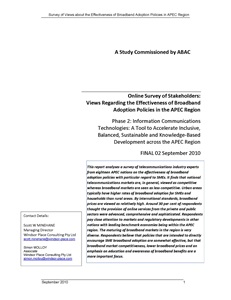
A study commissioned by ABAC. Online Survey of Stakeholders: Views Regarding the Effectiveness of Broadband Adoption Policies in the APEC Region
This report analyses a survey of telecommunication industry experts from 18 APEC economies on the effectiveness of broadband adoption policies with particular regard to SMEs. It finds that national telecommunications markets are, in general, viewed as competitive whereas broadband markets are seen as less competitive. Urban areas typically have higher rates of broadband adoption for SMEs and households than rural areas. By international standards, broadband prices are viewed as relatively high. Around 30 per cent of respondents thought the provision of online services from the private and public sectors were advanced, comprehensive and sophisticated. Respondents pay close attention to markets and regulatory developments in other nations with leading benchmark economies being within the APEC region. The maturing of broadband markets in the region is very diverse. Respondents believe that policies that are intended to directly encourage SME broadband adoption are somewhat effective, but that broadband market competitiveness, lower broadband prices and an emphasis on education and awareness of broadband benefits are a more important focus.
Proceedings
Discovering Innovative Food Processing Technology to Cultivate a Low-Carbon Food Supply Chain
Proceedings
Policies, Standards, and Best Practices for Recycling Plastic Intended for Contact with Food to Reduce Marine Plastic Pollution Among APEC Economies
Reports
APEC Meeting on Climate Resilient City – Navigating the Power of Science and Technology for Climate Resilient APEC