Reports
APEC Modernizing the Care Economy Project
The Asia-Pacific Economic Cooperation (APEC) is a regional economic forum established in 1989 to leverage the growing interdependence of the Asia-Pacific.
The Asia-Pacific Economic Cooperation (APEC) is a regional economic forum established in 1989 to leverage the growing interdependence of the Asia-Pacific.
APEC ensures that goods, services, investment and people move easily across borders. Members facilitate this trade through faster customs procedures at borders; more favorable business climates behind the border; and aligning regulations and standards across the region.
APEC ensures that goods, services, investment and people move easily across borders. Members facilitate this trade through faster customs procedures at borders; more favorable business climates behind the border; and aligning regulations and standards across the region.
APEC has helped drive economic growth and cooperation across the Asia-Pacific by reducing trade barriers, improving the ease of doing business and strengthening connectivity among economies. These efforts have contributed to rising incomes, expanded trade and greater opportunities for businesses and communities across the region.
APEC has helped drive economic growth and cooperation across the Asia-Pacific by reducing trade barriers, improving the ease of doing business and strengthening connectivity among economies. These efforts have contributed to rising incomes, expanded trade and greater opportunities for businesses and communities across the region.
APEC brings together governments, businesses and stakeholders to collaborate on shared priorities. Explore opportunities to participate in events, contribute to initiatives and engage with APEC’s work across the region.
APEC brings together governments, businesses and stakeholders to collaborate on shared priorities. Explore opportunities to participate in events, contribute to initiatives and engage with APEC’s work across the region.
Reports
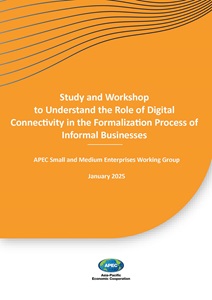
•January 2025
Download Report
1MB
Published Under
SOM Steering Committee on Economic and Technical Cooperation (SCE), Small and Medium Enterprises Working Group (SMEWG)
Accessed
946
Pages
123
In the context of promoting the formalization of informal business, digital connectivity emerges as a possibility for technology-based businesses, and others, to facilitate the transition to formality. Governments can increase the business performance by streamlining procedures, allowing submission of online applications, granting permits online, and being less bureaucratic in the formalization process. On the other hand, businesses need to legitimize themselves in order to be visible and access financial services, increasing productivity and expanding market share.
Therefore, this study is relevant to give greater understanding of the transition of informal economic actors to the formal economy, considering this topic is one of the priorities of Peru’s 2024 APEC Host Year.
This initiative supports the implementation of APEC Putrajaya Vision 2040, which underscores “to ensure that Asia-Pacific remains the world’s most dynamic and interconnected regional economy”, the Aotearoa Plan of Action, as it relates to the third economic driver: “Strong, Balanced, Secure, Sustainable and Inclusive Growth”, the APEC Internet and Digital Economy Roadmap (AIDER), among other strategic documents in APEC.