

Reports
Collaborative Development of Knowledge Discovery Approaches for Spatio-Temporal Prediction of Dry Spell to Predict Water Deficit Risk
The Asia-Pacific Economic Cooperation (APEC) is a regional economic forum established in 1989 to leverage the growing interdependence of the Asia-Pacific.
The Asia-Pacific Economic Cooperation (APEC) is a regional economic forum established in 1989 to leverage the growing interdependence of the Asia-Pacific.
APEC ensures that goods, services, investment and people move easily across borders. Members facilitate this trade through faster customs procedures at borders; more favorable business climates behind the border; and aligning regulations and standards across the region.
APEC ensures that goods, services, investment and people move easily across borders. Members facilitate this trade through faster customs procedures at borders; more favorable business climates behind the border; and aligning regulations and standards across the region.
APEC has helped drive economic growth and cooperation across the Asia-Pacific by reducing trade barriers, improving the ease of doing business and strengthening connectivity among economies. These efforts have contributed to rising incomes, expanded trade and greater opportunities for businesses and communities across the region.
APEC has helped drive economic growth and cooperation across the Asia-Pacific by reducing trade barriers, improving the ease of doing business and strengthening connectivity among economies. These efforts have contributed to rising incomes, expanded trade and greater opportunities for businesses and communities across the region.
APEC brings together governments, businesses and stakeholders to collaborate on shared priorities. Explore opportunities to participate in events, contribute to initiatives and engage with APEC’s work across the region.
APEC brings together governments, businesses and stakeholders to collaborate on shared priorities. Explore opportunities to participate in events, contribute to initiatives and engage with APEC’s work across the region.
Reports
•January 2025
Download Report
10MB
Published Under
SOM Steering Committee on Economic and Technical Cooperation (SCE), Policy Partnership on Women and the Economy (PPWE)
Accessed
940
Pages
35
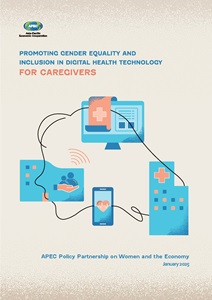
The health industry is undergoing digital transformation, and new technologies like health monitoring apps, telemedicine, and AI are being developed. According to the International Labor Organization, women are often primary caregivers, performing 80% of unpaid care work in the Asia-Pacific and making up 70% of global health workers. They are key users of these technologies. However, barriers like the digital gender gap and the lack of women’s perspectives in product design hinder their access. This project aims to promote gender equality in digital health technology development, focusing on the needs of caregivers to reduce their burdens and enhance efficiency.
This Summary Report contains summaries of the key activities of this project, which include findings from consultation interviews, a summary of a seminar and field trip, and policy recommendations from the aspect of (1) technology adoption by caregivers, (2) technology development and integration, and (3) cross-sector collaboration.
Reports
Collaborative Development of Knowledge Discovery Approaches for Spatio-Temporal Prediction of Dry Spell to Predict Water Deficit Risk

Manuals
APEC Guidebook on Early Detection of Diseases Affecting Tilapia and Rainbow Trout
Proceedings
Discovering Innovative Food Processing Technology to Cultivate a Low-Carbon Food Supply Chain