Proceedings
APEC Workshop on Higher Education in Standardization
The Asia-Pacific Economic Cooperation (APEC) is a regional economic forum established in 1989 to leverage the growing interdependence of the Asia-Pacific.
The Asia-Pacific Economic Cooperation (APEC) is a regional economic forum established in 1989 to leverage the growing interdependence of the Asia-Pacific.
APEC ensures that goods, services, investment and people move easily across borders. Members facilitate this trade through faster customs procedures at borders; more favorable business climates behind the border; and aligning regulations and standards across the region.
APEC ensures that goods, services, investment and people move easily across borders. Members facilitate this trade through faster customs procedures at borders; more favorable business climates behind the border; and aligning regulations and standards across the region.
APEC has helped drive economic growth and cooperation across the Asia-Pacific by reducing trade barriers, improving the ease of doing business and strengthening connectivity among economies. These efforts have contributed to rising incomes, expanded trade and greater opportunities for businesses and communities across the region.
APEC has helped drive economic growth and cooperation across the Asia-Pacific by reducing trade barriers, improving the ease of doing business and strengthening connectivity among economies. These efforts have contributed to rising incomes, expanded trade and greater opportunities for businesses and communities across the region.
APEC brings together governments, businesses and stakeholders to collaborate on shared priorities. Explore opportunities to participate in events, contribute to initiatives and engage with APEC’s work across the region.
APEC brings together governments, businesses and stakeholders to collaborate on shared priorities. Explore opportunities to participate in events, contribute to initiatives and engage with APEC’s work across the region.
Reports
•February 2024
Download Report
347KB
Published Under
APEC Secretariat, APEC Policy Support Unit
Accessed
11235
Pages
11
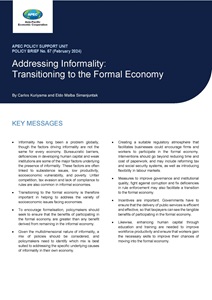
This Policy Brief identifies the root causes of informality and discusses what is required at the policy level to address informality and promote a proper transition to a formal economy. Informality has long been a problem globally, with different nuances among economies. Bureaucratic barriers, deficiencies in developing human capital and weak institutions are among some of the major factors explaining the presence of informality, which has many negative associations to low productivity, socioeconomic vulnerability, poverty, unfair competition, tax evasion and lack of compliance to rules, among others.
Given the multidimensional nature of informality, a mix of policies should be considered. They include the need to create a suitable regulatory atmosphere that facilitates businesses; measures to improve governance, institutional quality and rule enforcement; incentives for compliance; and enhancing human capital through education and training.