Proceedings
APEC Workshop on Higher Education in Standardization
The Asia-Pacific Economic Cooperation (APEC) is a regional economic forum established in 1989 to leverage the growing interdependence of the Asia-Pacific.
The Asia-Pacific Economic Cooperation (APEC) is a regional economic forum established in 1989 to leverage the growing interdependence of the Asia-Pacific.
APEC ensures that goods, services, investment and people move easily across borders. Members facilitate this trade through faster customs procedures at borders; more favorable business climates behind the border; and aligning regulations and standards across the region.
APEC ensures that goods, services, investment and people move easily across borders. Members facilitate this trade through faster customs procedures at borders; more favorable business climates behind the border; and aligning regulations and standards across the region.
APEC has helped drive economic growth and cooperation across the Asia-Pacific by reducing trade barriers, improving the ease of doing business and strengthening connectivity among economies. These efforts have contributed to rising incomes, expanded trade and greater opportunities for businesses and communities across the region.
APEC has helped drive economic growth and cooperation across the Asia-Pacific by reducing trade barriers, improving the ease of doing business and strengthening connectivity among economies. These efforts have contributed to rising incomes, expanded trade and greater opportunities for businesses and communities across the region.
APEC brings together governments, businesses and stakeholders to collaborate on shared priorities. Explore opportunities to participate in events, contribute to initiatives and engage with APEC’s work across the region.
APEC brings together governments, businesses and stakeholders to collaborate on shared priorities. Explore opportunities to participate in events, contribute to initiatives and engage with APEC’s work across the region.
Manuals
•December 2023
Download Report
1MB
Published Under
SOM Steering Committee on Economic and Technical Cooperation (SCE), Human Resources Development Working Group (HRDWG)
Accessed
1906
Pages
51
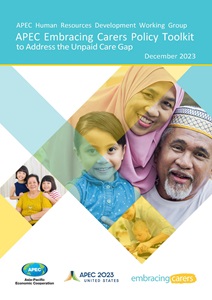
The APEC Embracing Carers Policy Toolkit to Address the Unpaid Care Gap (Toolkit) puts forward policy examples, case studies, and implementation steps to help all stakeholders better support caregivers, most of whom are women. To make the case for investing in the care economy, the Toolkit incorporates the “5R framework for decent care”, a model of action-oriented policy objectives developed by the ILO and adopted by other multilateral organizations, to guide the implementation of effective interventions for unpaid care.
The Toolkit was informed by the foundational literature put forward by international organizations and academics. The project convened an Expert Advisory Group with representation across government, private sector, multilaterals, and civil society who lent their expertise in advocating for policies that address harmful gender norms and gender-based discrimination and create conditions that allow everyone to participate in both the labor force and caregiving.