

Reports
Advancing Economic Development in the APEC Region: Best Practices for Smart Human–Machine Collaboration in the Heavy Steel Construction Industry
The Asia-Pacific Economic Cooperation (APEC) is a regional economic forum established in 1989 to leverage the growing interdependence of the Asia-Pacific.
The Asia-Pacific Economic Cooperation (APEC) is a regional economic forum established in 1989 to leverage the growing interdependence of the Asia-Pacific.
APEC ensures that goods, services, investment and people move easily across borders. Members facilitate this trade through faster customs procedures at borders; more favorable business climates behind the border; and aligning regulations and standards across the region.
APEC ensures that goods, services, investment and people move easily across borders. Members facilitate this trade through faster customs procedures at borders; more favorable business climates behind the border; and aligning regulations and standards across the region.
APEC has helped drive economic growth and cooperation across the Asia-Pacific by reducing trade barriers, improving the ease of doing business and strengthening connectivity among economies. These efforts have contributed to rising incomes, expanded trade and greater opportunities for businesses and communities across the region.
APEC has helped drive economic growth and cooperation across the Asia-Pacific by reducing trade barriers, improving the ease of doing business and strengthening connectivity among economies. These efforts have contributed to rising incomes, expanded trade and greater opportunities for businesses and communities across the region.
APEC brings together governments, businesses and stakeholders to collaborate on shared priorities. Explore opportunities to participate in events, contribute to initiatives and engage with APEC’s work across the region.
APEC brings together governments, businesses and stakeholders to collaborate on shared priorities. Explore opportunities to participate in events, contribute to initiatives and engage with APEC’s work across the region.
Reports
•November 2022
Download Report
626KB
Published Under
APEC Secretariat, APEC Policy Support Unit
Accessed
3943
Pages
11
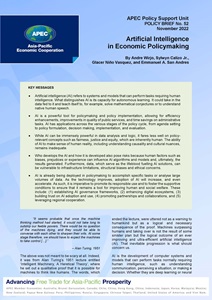
Artificial Intelligence (AI) is a powerful tool for policymaking and policy implementation, allowing for efficiency enhancements, improvements in quality of public services, and time savings on administrative tasks. AI has applications across the various stages of the policy cycle, from agenda setting to policy formulation, decision making, implementation and evaluation. But while AI can be immensely powerful in data analysis and logic, it fares less well on policy-relevant concepts such as fairness, justice and equity, which are inherently human. The ability of AI to make sense of human reality, including understanding causality and cultural nuances, remains inadequate. Factors such as biases, prejudices or experience can influence AI algorithms and models and, ultimately, the results generated. This policy brief analyses the benefits and limitations of the use of AI in policymaking, and discusses policy options to ensure that the AI-augmented future remains human-centric.
Reports
Advancing Economic Development in the APEC Region: Best Practices for Smart Human–Machine Collaboration in the Heavy Steel Construction Industry
Proceedings
APEC Workshop on Shaping Digital Transformation in Accreditation
Manuals
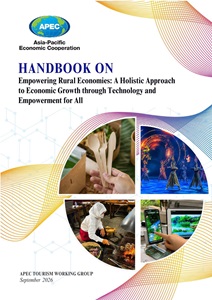
Empowering Rural Economies: A Holistic Approach to Economic Growth through Technology and Empowerment for All