

Reports
Advancing Economic Development in the APEC Region: Best Practices for Smart Human–Machine Collaboration in the Heavy Steel Construction Industry
The Asia-Pacific Economic Cooperation (APEC) is a regional economic forum established in 1989 to leverage the growing interdependence of the Asia-Pacific.
The Asia-Pacific Economic Cooperation (APEC) is a regional economic forum established in 1989 to leverage the growing interdependence of the Asia-Pacific.
APEC ensures that goods, services, investment and people move easily across borders. Members facilitate this trade through faster customs procedures at borders; more favorable business climates behind the border; and aligning regulations and standards across the region.
APEC ensures that goods, services, investment and people move easily across borders. Members facilitate this trade through faster customs procedures at borders; more favorable business climates behind the border; and aligning regulations and standards across the region.
APEC has helped drive economic growth and cooperation across the Asia-Pacific by reducing trade barriers, improving the ease of doing business and strengthening connectivity among economies. These efforts have contributed to rising incomes, expanded trade and greater opportunities for businesses and communities across the region.
APEC has helped drive economic growth and cooperation across the Asia-Pacific by reducing trade barriers, improving the ease of doing business and strengthening connectivity among economies. These efforts have contributed to rising incomes, expanded trade and greater opportunities for businesses and communities across the region.
APEC brings together governments, businesses and stakeholders to collaborate on shared priorities. Explore opportunities to participate in events, contribute to initiatives and engage with APEC’s work across the region.
APEC brings together governments, businesses and stakeholders to collaborate on shared priorities. Explore opportunities to participate in events, contribute to initiatives and engage with APEC’s work across the region.
Reports
•August 2022
Download Report
3MB
Published Under
SOM Steering Committee on Economic and Technical Cooperation (SCE), Emergency Preparedness Working Group (EPWG)
Accessed
1719
Pages
16
Disasters and COVID-19 pandemic have a far more negative impact on groups both epidemiologically and socioeconomically in the Asia-Pacific, a region with highest impact on global population (87%) from natural hazards. This policy brief aims at providing a new insight into key recommendations and prospective agenda to rejuvenate vulnerable cities and increase the resilience capacities as a result of systemic risk, emerging hazard, compound disaster driven by extreme weather events, climate change and COVID-19 pandemic. Four priorities are recommended: (1) Assessing new emerging hazards and future systemic risks in the vulnerable area; (2) Strengthening risk governance and communication for rapid decision-making for action; (3) Diversifying investment strategies for local resilience; and (4) Empowering locally-led and nationally-supported disaster risk reduction (DRR) and resilience program. A transdisciplinary approach is promoted to integrate public health and DRR to prevent future pandemic risk, rebuild vulnerable societies, and strengthen resilient cities in an extreme climate.
Reports
Advancing Economic Development in the APEC Region: Best Practices for Smart Human–Machine Collaboration in the Heavy Steel Construction Industry
Proceedings
APEC Workshop on Shaping Digital Transformation in Accreditation
Manuals
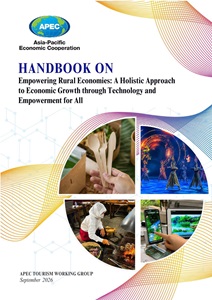
Empowering Rural Economies: A Holistic Approach to Economic Growth through Technology and Empowerment for All