Proceedings
Empowering Inclusive APEC Resilient City and Community for Sustainable Development
The Asia-Pacific Economic Cooperation (APEC) is a regional economic forum established in 1989 to leverage the growing interdependence of the Asia-Pacific.
The Asia-Pacific Economic Cooperation (APEC) is a regional economic forum established in 1989 to leverage the growing interdependence of the Asia-Pacific.
APEC ensures that goods, services, investment and people move easily across borders. Members facilitate this trade through faster customs procedures at borders; more favorable business climates behind the border; and aligning regulations and standards across the region.
APEC ensures that goods, services, investment and people move easily across borders. Members facilitate this trade through faster customs procedures at borders; more favorable business climates behind the border; and aligning regulations and standards across the region.
APEC has helped drive economic growth and cooperation across the Asia-Pacific by reducing trade barriers, improving the ease of doing business and strengthening connectivity among economies. These efforts have contributed to rising incomes, expanded trade and greater opportunities for businesses and communities across the region.
APEC has helped drive economic growth and cooperation across the Asia-Pacific by reducing trade barriers, improving the ease of doing business and strengthening connectivity among economies. These efforts have contributed to rising incomes, expanded trade and greater opportunities for businesses and communities across the region.
APEC brings together governments, businesses and stakeholders to collaborate on shared priorities. Explore opportunities to participate in events, contribute to initiatives and engage with APEC’s work across the region.
APEC brings together governments, businesses and stakeholders to collaborate on shared priorities. Explore opportunities to participate in events, contribute to initiatives and engage with APEC’s work across the region.
Reports
•March 2022
Download Report
4MB
Published Under
APEC Secretariat, APEC Policy Support Unit
Accessed
3284
Pages
96
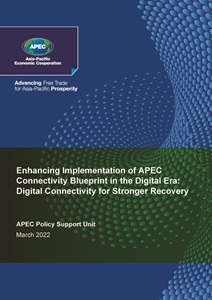
This report addresses how APEC members can take advantage of the innovative and productive opportunities offered by greater digital connectivity. It begins with a discussion on the recent trends, best practices and challenges in the three pillars of connectivity. It then analyses the eight case studies that were submitted by APEC members for this report and information on relevant initiatives that was provided by APEC members for the 2020 Mid-Term Review of the APEC Connectivity Blueprint. The analysis shows that APEC members have taken a variety of approaches towards improving digital connectivity. However, key challenges to achieving greater digital connectivity remain and which will require innovative solutions from both the public and private sectors. The four main challenges are: 1) reducing the digital divide; 2) improving interoperability of digital systems and ensuring data security; 3) fostering greater regulatory cooperation to support the digital economy; and 4) maximizing digital dividends and spillover benefits. The report concludes with policy recommendations on how strengthening efforts in the implementation of the APEC Connectivity Blueprint in these areas will help members reap the greatest potential benefits that are provided by the digital economy.