

Reports
Advancing Economic Development in the APEC Region: Best Practices for Smart Human–Machine Collaboration in the Heavy Steel Construction Industry
The Asia-Pacific Economic Cooperation (APEC) is a regional economic forum established in 1989 to leverage the growing interdependence of the Asia-Pacific.
The Asia-Pacific Economic Cooperation (APEC) is a regional economic forum established in 1989 to leverage the growing interdependence of the Asia-Pacific.
APEC ensures that goods, services, investment and people move easily across borders. Members facilitate this trade through faster customs procedures at borders; more favorable business climates behind the border; and aligning regulations and standards across the region.
APEC ensures that goods, services, investment and people move easily across borders. Members facilitate this trade through faster customs procedures at borders; more favorable business climates behind the border; and aligning regulations and standards across the region.
APEC has helped drive economic growth and cooperation across the Asia-Pacific by reducing trade barriers, improving the ease of doing business and strengthening connectivity among economies. These efforts have contributed to rising incomes, expanded trade and greater opportunities for businesses and communities across the region.
APEC has helped drive economic growth and cooperation across the Asia-Pacific by reducing trade barriers, improving the ease of doing business and strengthening connectivity among economies. These efforts have contributed to rising incomes, expanded trade and greater opportunities for businesses and communities across the region.
APEC brings together governments, businesses and stakeholders to collaborate on shared priorities. Explore opportunities to participate in events, contribute to initiatives and engage with APEC’s work across the region.
APEC brings together governments, businesses and stakeholders to collaborate on shared priorities. Explore opportunities to participate in events, contribute to initiatives and engage with APEC’s work across the region.
Reports
•November 2019
Download Report
3MB
Published Under
APEC Secretariat, APEC Policy Support Unit
Accessed
10007
Pages
33
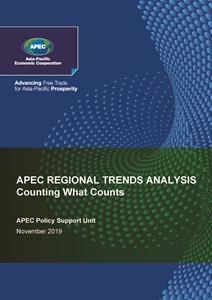
Gross domestic product (GDP) is an important barometer of economic health, providing estimates of the value of all goods and services produced within an economy. GDP and its related concepts, such as economic growth and productivity, dominate policy discussions and are often used as a proxy of economic achievement. The theme chapter of the APEC Regional Trends Analysis discusses the limitations and nuances of GDP: it provides vital indicators of economic output and risk, but is unable to inform on other important aspects of the economy such as wellbeing or sustainability. Economic policy discussions need to go beyond GDP and complement it with other measures that can inform on the distribution of economic benefits, the environmental costs of production, and the increasing importance of data in the digital economy.
The next chapter on economic and trade trends shows that the APEC region grew at a slower pace in January-June 2019 at 3.6 percent compared to a GDP growth of 4.3 percent in January-June 2018, as uncertainty on the external front dampened investments and consumer spending. In the short-term period covering 2019-2021, APEC is expected to continue to grow but at a moderated pace, in tandem with the global economy. Risks of a further escalation in trade and technology tensions remain, which could further weaken the global economy. Amid elevated uncertainty, which has adversely affected traditional growth drivers such as consumption and trade, APEC needs to diversify sources of economic growth by boosting the services sector, taking advantage of digital opportunities, ensuring financial inclusion, and increasing women’s economic participation towards sustainable and inclusive growth.
Reports
Advancing Economic Development in the APEC Region: Best Practices for Smart Human–Machine Collaboration in the Heavy Steel Construction Industry
Proceedings
APEC Workshop on Shaping Digital Transformation in Accreditation
Manuals
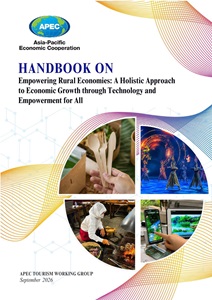
Empowering Rural Economies: A Holistic Approach to Economic Growth through Technology and Empowerment for All