Reports
How Trade Winds Have Shifted: Structural Changes in Trade Dynamism in the APEC Region
The Asia-Pacific Economic Cooperation (APEC) is a regional economic forum established in 1989 to leverage the growing interdependence of the Asia-Pacific.
The Asia-Pacific Economic Cooperation (APEC) is a regional economic forum established in 1989 to leverage the growing interdependence of the Asia-Pacific.
APEC ensures that goods, services, investment and people move easily across borders. Members facilitate this trade through faster customs procedures at borders; more favorable business climates behind the border; and aligning regulations and standards across the region.
APEC ensures that goods, services, investment and people move easily across borders. Members facilitate this trade through faster customs procedures at borders; more favorable business climates behind the border; and aligning regulations and standards across the region.
APEC has helped drive economic growth and cooperation across the Asia-Pacific by reducing trade barriers, improving the ease of doing business and strengthening connectivity among economies. These efforts have contributed to rising incomes, expanded trade and greater opportunities for businesses and communities across the region.
APEC has helped drive economic growth and cooperation across the Asia-Pacific by reducing trade barriers, improving the ease of doing business and strengthening connectivity among economies. These efforts have contributed to rising incomes, expanded trade and greater opportunities for businesses and communities across the region.
APEC brings together governments, businesses and stakeholders to collaborate on shared priorities. Explore opportunities to participate in events, contribute to initiatives and engage with APEC’s work across the region.
APEC brings together governments, businesses and stakeholders to collaborate on shared priorities. Explore opportunities to participate in events, contribute to initiatives and engage with APEC’s work across the region.
Reports
•December 2020
Download Report
737KB
Published Under
SOM Steering Committee on Economic and Technical Cooperation (SCE), Small and Medium Enterprises Working Group (SMEWG)
Accessed
1564
Pages
10
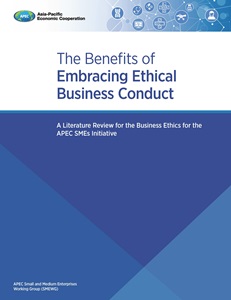
Common wisdom and ample evidence demonstrate the negative impact that corruption has on public welfare and economies. Understanding the costs of corruption alone may not provide sufficient motivation to alter the behavior of companies or individuals. This literature review covers published work on the cost of unethical conduct in tandem with scholarly insights on gains from adopting ethical practices at the firm level, providing a compelling foundation for action that has thus far not been available. Guided by consultation with experts in the field of business ethics and drawing from published research from academia and multilateral organizations, this collection of literature demonstrates that enterprises worldwide, especially small and medium enterprises (SMEs), stand not only to avoid harm but also to tangibly benefit from embracing ethical practices.