

Proceedings
Discovering Innovative Food Processing Technology to Cultivate a Low-Carbon Food Supply Chain
The Asia-Pacific Economic Cooperation (APEC) is a regional economic forum established in 1989 to leverage the growing interdependence of the Asia-Pacific.
The Asia-Pacific Economic Cooperation (APEC) is a regional economic forum established in 1989 to leverage the growing interdependence of the Asia-Pacific.
APEC ensures that goods, services, investment and people move easily across borders. Members facilitate this trade through faster customs procedures at borders; more favorable business climates behind the border; and aligning regulations and standards across the region.
APEC ensures that goods, services, investment and people move easily across borders. Members facilitate this trade through faster customs procedures at borders; more favorable business climates behind the border; and aligning regulations and standards across the region.
APEC has helped drive economic growth and cooperation across the Asia-Pacific by reducing trade barriers, improving the ease of doing business and strengthening connectivity among economies. These efforts have contributed to rising incomes, expanded trade and greater opportunities for businesses and communities across the region.
APEC has helped drive economic growth and cooperation across the Asia-Pacific by reducing trade barriers, improving the ease of doing business and strengthening connectivity among economies. These efforts have contributed to rising incomes, expanded trade and greater opportunities for businesses and communities across the region.
APEC brings together governments, businesses and stakeholders to collaborate on shared priorities. Explore opportunities to participate in events, contribute to initiatives and engage with APEC’s work across the region.
APEC brings together governments, businesses and stakeholders to collaborate on shared priorities. Explore opportunities to participate in events, contribute to initiatives and engage with APEC’s work across the region.
Reports
•August 2020
Download Report
967KB
Published Under
SOM Steering Committee on Economic and Technical Cooperation (SCE), Small and Medium Enterprises Working Group (SMEWG)
Accessed
1391
Pages
12
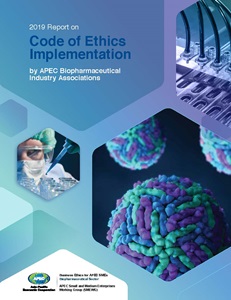
Launched in 2010, the Business Ethics for APEC SMEs Initiative biopharmaceutical sector program actively supports the adoption and implementation of voluntary codes of ethics by the region’s relevant industry associations. These associations include thousands of small and medium-sized enterprises that constitute the overwhelming majority of firms operating in the region’s biopharmaceutical sector.
Welcomed by APEC Economic Leaders and Ministers, this Initiative – the largest public-private partnership of its kind in the world – realizes the best practices set by the APEC Mexico City Principles in 2010 through implementation of the actions set forth in the APEC Nanjing Declaration to Promoting Ethical Environments in the Medical Device and Biopharmaceutical Sectors. Monitoring and evaluation of code adoption and implementation by the APEC region’s biopharmaceutical industry associations serves as one of the Initiative’s core activities.This is done through an annual survey program extended to every known biopharmaceutical industry association in the region.To-date, the Initiative monitors 71 biopharmaceutical industry associations that represent a significant majority of the regional biopharmaceutical economy. These annual surveys are divided into two components: code of ethics adoption and code of ethics implementation.
Proceedings
Discovering Innovative Food Processing Technology to Cultivate a Low-Carbon Food Supply Chain
Proceedings
Policies, Standards, and Best Practices for Recycling Plastic Intended for Contact with Food to Reduce Marine Plastic Pollution Among APEC Economies
Reports
APEC Meeting on Climate Resilient City – Navigating the Power of Science and Technology for Climate Resilient APEC