Reports
APEC Modernizing the Care Economy Project
The Asia-Pacific Economic Cooperation (APEC) is a regional economic forum established in 1989 to leverage the growing interdependence of the Asia-Pacific.
The Asia-Pacific Economic Cooperation (APEC) is a regional economic forum established in 1989 to leverage the growing interdependence of the Asia-Pacific.
APEC ensures that goods, services, investment and people move easily across borders. Members facilitate this trade through faster customs procedures at borders; more favorable business climates behind the border; and aligning regulations and standards across the region.
APEC ensures that goods, services, investment and people move easily across borders. Members facilitate this trade through faster customs procedures at borders; more favorable business climates behind the border; and aligning regulations and standards across the region.
APEC has helped drive economic growth and cooperation across the Asia-Pacific by reducing trade barriers, improving the ease of doing business and strengthening connectivity among economies. These efforts have contributed to rising incomes, expanded trade and greater opportunities for businesses and communities across the region.
APEC has helped drive economic growth and cooperation across the Asia-Pacific by reducing trade barriers, improving the ease of doing business and strengthening connectivity among economies. These efforts have contributed to rising incomes, expanded trade and greater opportunities for businesses and communities across the region.
APEC brings together governments, businesses and stakeholders to collaborate on shared priorities. Explore opportunities to participate in events, contribute to initiatives and engage with APEC’s work across the region.
APEC brings together governments, businesses and stakeholders to collaborate on shared priorities. Explore opportunities to participate in events, contribute to initiatives and engage with APEC’s work across the region.
Reports
•July 2009
Download Report
4MB
Published Under
CTI Sub-Fora & Industry Dialogues Groups, Investment Expert Group (IEG)
Accessed
8976
Pages
211
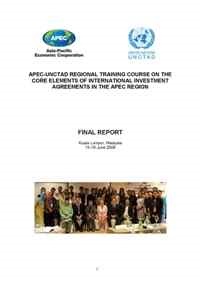
The course curriculum and material was prepared by UNCTAD's work programme on IIAs to enable the participants in obtaining the necessary expertise on the negotiation and implementation of IIAs.
The final report and presentations of the training course can be downloaded individually.
Affendi - ICSID Malaysia Experience
285KB
Faya - Expropriation and Compensation
638KB
Faya - MFN Treatment
218KB
Faya - National Treatment
319KB
Final Report
842KB
Gonzalez - Pre Establishment
117KB
Gonzalez - Scope and Definition Chile
148KB
Joubin-Bret - 3 Generations Investment Promotion
241KB
Joubin-Bret - Admission and Establishment
118KB
Joubin-Bret - Dispute Settlement in IIAs
107KB
Joubin-Bret - ICSID
74KB
Joubin-Bret - Interactions and Policy Coherence
129KB
Joubin-Bret - Investment Promotion Provisions in IIAs
182KB
Joubin-Bret - Investor-State Dispute Settlement
105KB
Joubin-Bret - Scope and Definitions
191KB
Joubin-Bret - Transfer of Funds
70KB
Jusoh - Consistency Inconsistency ASEAN
96KB
Knoerich - International Investment Rulemaking
462KB
Pawlak - Avoidance and Settlement
177KB
Pawlak - Fair and Equitable Treatment
254KB
Pawlak - Managing Investment Disputes
148KB
Pawlak - Transfer of Funds
203KB
Presentations
203KB
Rivas Plata Barrientos - Peruvian Dispute Coordination System
101KB
Shan - Fair and Equitable Treatment
218KB
Shan - National Treatment
206KB
Sugano - Coherence in IIAs
152KB
Sugano - Scheduling of Reservations
280KB
Vilawan - Expropriation
56KB
Vilawan - ISDS Thailand
57KB