

Proceedings
Policies, Standards, and Best Practices for Recycling Plastic Intended for Contact with Food to Reduce Marine Plastic Pollution Among APEC Economies
The Asia-Pacific Economic Cooperation (APEC) is a regional economic forum established in 1989 to leverage the growing interdependence of the Asia-Pacific.
The Asia-Pacific Economic Cooperation (APEC) is a regional economic forum established in 1989 to leverage the growing interdependence of the Asia-Pacific.
APEC ensures that goods, services, investment and people move easily across borders. Members facilitate this trade through faster customs procedures at borders; more favorable business climates behind the border; and aligning regulations and standards across the region.
APEC ensures that goods, services, investment and people move easily across borders. Members facilitate this trade through faster customs procedures at borders; more favorable business climates behind the border; and aligning regulations and standards across the region.
APEC has helped drive economic growth and cooperation across the Asia-Pacific by reducing trade barriers, improving the ease of doing business and strengthening connectivity among economies. These efforts have contributed to rising incomes, expanded trade and greater opportunities for businesses and communities across the region.
APEC has helped drive economic growth and cooperation across the Asia-Pacific by reducing trade barriers, improving the ease of doing business and strengthening connectivity among economies. These efforts have contributed to rising incomes, expanded trade and greater opportunities for businesses and communities across the region.
APEC brings together governments, businesses and stakeholders to collaborate on shared priorities. Explore opportunities to participate in events, contribute to initiatives and engage with APEC’s work across the region.
APEC brings together governments, businesses and stakeholders to collaborate on shared priorities. Explore opportunities to participate in events, contribute to initiatives and engage with APEC’s work across the region.
Proceedings
•November 2024
Download Report
3MB
Published Under
SOM Steering Committee on Economic and Technical Cooperation (SCE), Small and Medium Enterprises Working Group (SMEWG)
Accessed
1021
Pages
69
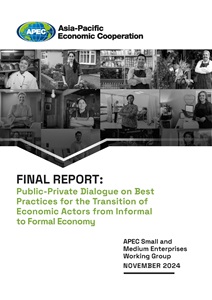
The report "Public-Private Dialogue on Best Practices for the Transition from Informal to Formal Economy" explores strategies to address the challenges of informal economic activity within APEC economies. Conducted under the APEC SME Working Group’s project SME 01 2023, the dialogue took place on 13-14 May 2024, in Arequipa, Peru, gathering experts from governments, the private sector, and academia.
The publication emphasizes that the informal economy accounts for over 50% of the global workforce, posing challenges such as lower productivity, reduced government revenue, and heightened social inequalities. Key recommendations include leveraging digital platforms to simplify formalization, providing financial incentives like tax breaks, and fostering public-private collaboration. It also highlights the need for inclusive policies targeting women, youth, and rural populations.
This report encourages APEC economies to adopt streamlined regulations, promote financial inclusion, and prioritize digital tools to create an accessible formal economy that supports sustainable growth and social equity across the region.
Proceedings
Policies, Standards, and Best Practices for Recycling Plastic Intended for Contact with Food to Reduce Marine Plastic Pollution Among APEC Economies
Reports
Case Study Report on Sustainable Utilization of Marine Biological Resources in the Asia-Pacific Region
Proceedings
Empowering Inclusive APEC Resilient City and Community for Sustainable Development