

Defusing Investment Disputes before They Escalate
.png?sfvrsn=af899c89_1)
Small regulatory frictions can escalate into costly investment disputes. Early intervention and effective dialogue can help governments resolve grievances, protect investor confidence and keep investment projects on track.
Imagine a foreign investor enters the market with a promising project. Initial engagement with authorities is positive and encouraging. Over time, however, small frictions begin to emerge. Inconsistent guidance creates confusion and brings uncertainty. Delayed processes increase costs. Unpredictable policy environment could trigger disputes.
For example, sudden regulatory changes affecting conditions agreed in investment treaties or tax stability agreements could generate losses in investors. In certain extreme cases, unresolved tensions can escalate further, resulting in arbitrary expropriations or project closures.
When these problems emerge, some investors may initiate disputes against host economies through domestic courts or investor-state dispute settlement (ISDS) mechanisms, such as those available under bilateral investment treaties, free trade agreements or other mechanisms under the International Centre for Settlement of Investment Disputes (ICSID), the United Nations Commission on International Trade Law (UNCITRAL), among others.
However, these proceedings are often lengthy bringing uncertainty to investors. In addition, legal fees can impose significant financial burden on them.
Foreign investment has long driven growth in the Asia-Pacific. Nowadays, as supply chains reconfigure and industries digitalize, competition is intensifying among economies to attract high‑value projects. One factor stands out to shape investor decisions: predictability. Investors are not only chasing opportunities, but also choosing locations where governments are reliable, predictable and fair.
Why early intervention matters
Investor grievances often emerge long before they develop into a formal legal dispute. Concerns may first surface through informal conversations, public consultations or media reports. While these signals may sometimes appear minor, they may serve as early warning signs. This creates a critical window where preventive measures can be most effective.
When early dispute signals are missed, small sparks can turn into fires. What begins as a minor frustration evolves into a formal grievance and, eventually, a legal claim. By the time a dispute reaches arbitration or legal courts, the financial, administrative and reputational costs have multiplied.
The consequences for governments are negative. Disputes can delay projects, weaken investor trust and affect perceptions of an economy’s business atmosphere.
Well-designed dispute prevention systems can help reduce these risks. They support faster resolution, lower legal risks, smoother navigation of government processes and a more stable business environment. Importantly, they also help preserve constructive relationships between government and investors, regardless of their origin.
When investors know there is a credible channel for consultation and dialogue, they are more likely to raise concerns at an early stage and engage constructively to seek solutions. Effective dispute preventive systems are not designed to assign blame or win disputes. Rather, they aim to address concerns and respond swiftly before frustration escalates into confrontation.
Recent research by the APEC Policy Support Unit (PSU) offers a timely look at how economies across the region are strengthening dispute prevention and mitigation mechanisms, which are highlighted within the red-framed area in Figure 1. These systems are designed to identify and address investor grievances early, before they escalate into formal legal proceedings.
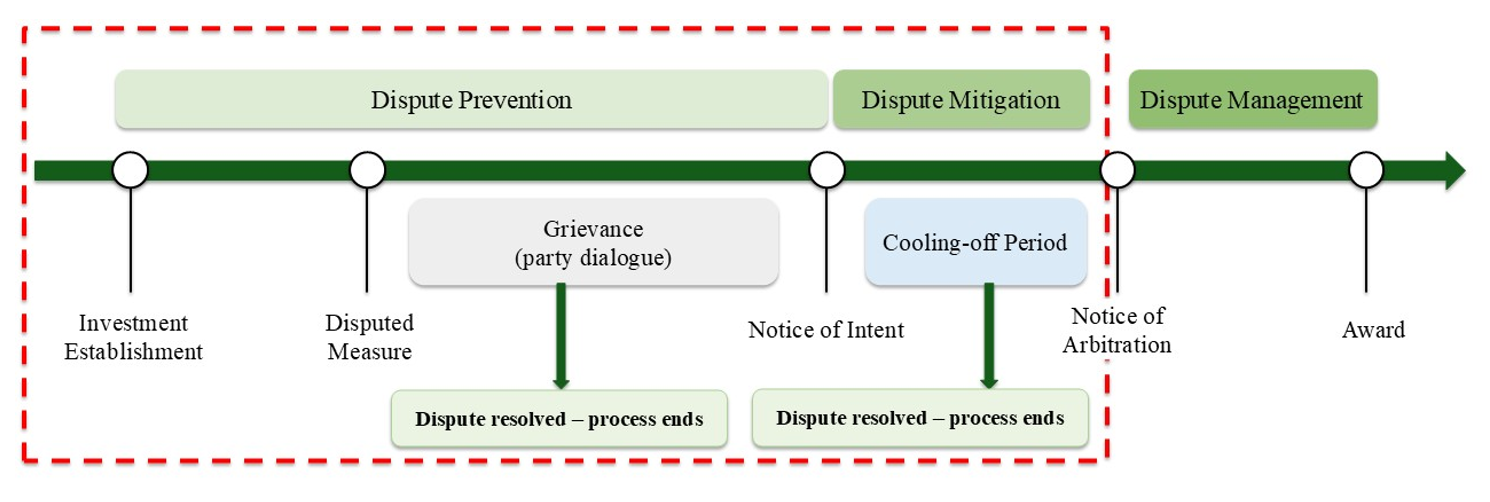
Figure 1: Schematic illustration of the concepts of dispute prevention and dispute mitigation
Several APEC economies have established early-stage grievance mechanisms, often designed as one-stop contact points for foreign investors. These mechanisms are empowered to coordinate across government agencies and work toward practical solutions before conflicts escalate into legal proceedings.
Institutional diversity: building systems that inspire trust
The PSU study also highlights institutional diversity of dispute prevention systems across APEC economies.
Existing mechanisms vary in institutional form, legal authority and operational role. Some operate as semi-independent bodies, others sit within a single authority and some function primarily as coordination platforms across agencies.
This diversity reflects the different constitutional, administrative and political contexts across economies. There is no single model that works for everyone. A mechanism that performs well in one economy may not necessarily be suitable in another.
Therefore. designing grievance mechanisms requires careful institutional choices regarding mandate, authority, independence and timing. Aligning these mechanisms with domestic conditions is essential for building long-term credibility and trust.
Importantly, dispute prevention and mitigation mechanisms are meant to complement, not replace, formal dispute resolution processes such as ISDS. They provide an earlier, less adversarial avenue for dialogue, ideally helping resolve concerns before they escalate into formal legal proceedings.
The role of firms in dispute prevention
While institutional mechanisms provide the foundation for dispute prevention, their outcome can also be affected by how investors themselves participate in the system.
Recent PSU research on long-term FDI underscores a crucial, but often overlooked dimension of dispute prevention: the role played by firms. Leading FDI firms are encouraged to take a proactive action including building structured communication channels, maintaining transparent relationships with governments and adopt internal grievance mechanisms to address concerns early.
These findings highlight that effective dispute prevention is not solely a government function, it also depends on how firms manage relationships, communication and grievances over the course of an investment project.
In an increasingly competitive global investment environment, predictability matters more than ever.
Effective dispute prevention systems can help economies strengthen investor confidence, reduce uncertainty and support more sustainable, high-quality investment flows across the APEC region. As economies compete for long-term investment, building trust early may prove even more important than resolving disputes later.
Yan-Rong Chang is a researcher and Dr Akhmad Bayhaqi is a senior analyst at the APEC Policy Support Unit.