

Technology Optimism Meets Rising Economic Risks

Investments in new and emerging technologies, alongside timely policy actions are helping sustain economic growth across the APEC region despite mounting headwinds. Yet surging energy and food prices, persistent geopolitical tensions and tightening financial conditions continue to cloud the outlook. With growth increasingly uneven across APEC economies, ensuring that its benefits are widely shared will require not only agile macroeconomic policies and diversified trade and investments, but also stronger regional cooperation.
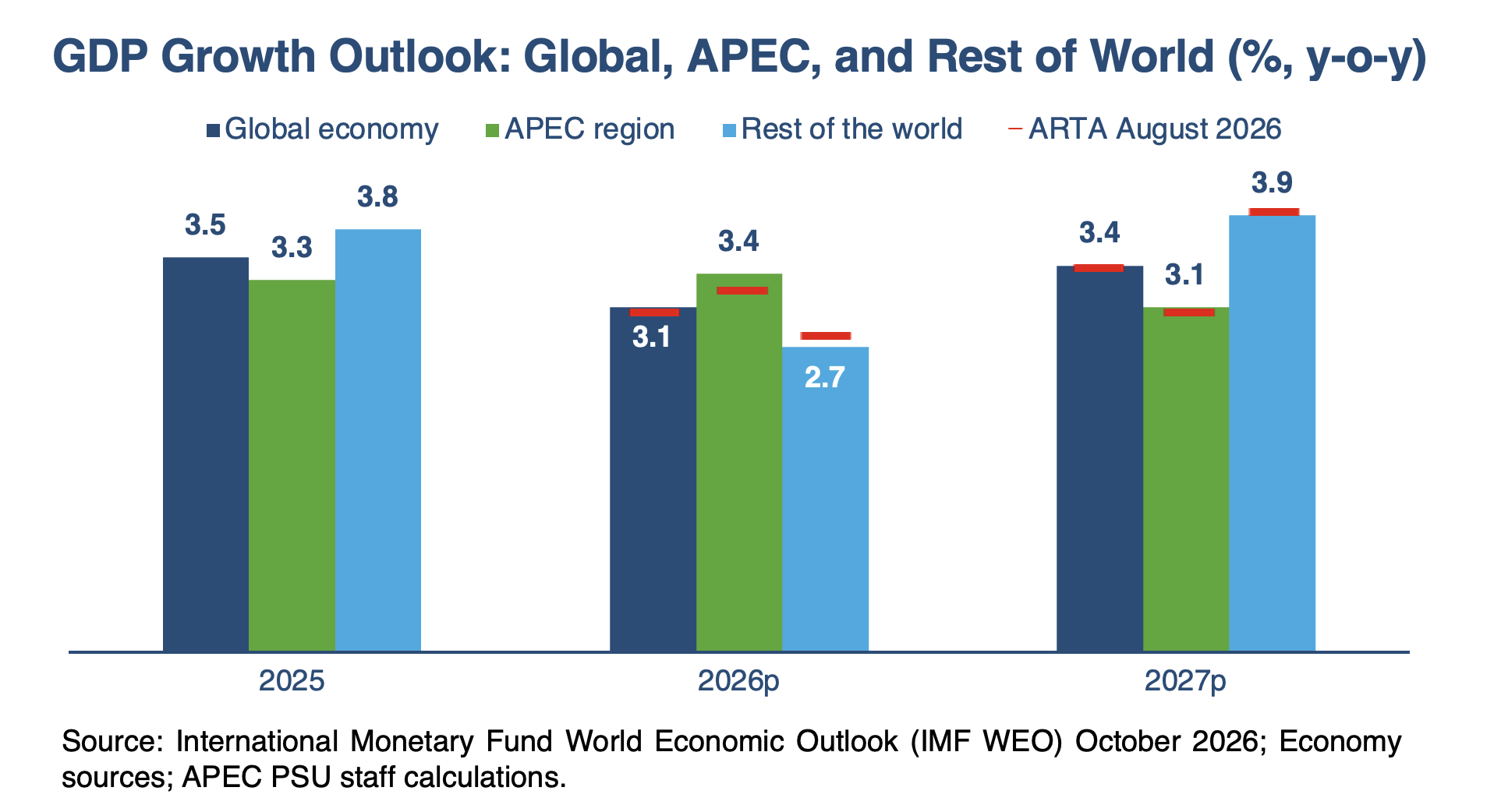
The APEC region is projected to grow by 3.4 percent in 2026, up from 3.3 percent in 2025 and above the 3.2 percent forecast in the August 2026 APEC Regional Trends Analysis (ARTA).
Strong investments in new and emerging technology, including data centers, semiconductors and computing capacity, as well as timely policy responses have supported economic activity despite supply disruptions linked to tensions in the Middle East and the El Niño phenomenon.
However, growth is expected to moderate to 3.1 percent in 2027, trailing the global economy by 0.3 percentage points.
The technology sector continues to fuel market optimism, with technology and semiconductor stocks leading global equity markets on expectations of robust demand. Rising prices for electronics and industrial metals also reflect this demand. However, elevated stock valuations heighten the risk of a market correction, particularly if the anticipated boost to productivity fail to materialize or investor sentiment shifts.
The benefits of investments in new and emerging technologies are unlikely to be distributed evenly. Economies with the financial resources, infrastructure and skilled workers needed to adopt these technologies are better positioned to capture productivity gains. Those with limited investment capacity risk falling further behind, potentially widening existing economic and technological divides.
Risks to the economic outlook remain tilted to the downside. Prolonged geopolitical and trade tensions could weaken business confidence, disrupt supply chains and dampen economic activity.
Extreme weather events could add to these pressures by disrupting production and distribution, and driving up prices. Meanwhile, if investments in new and emerging technologies fall short of expectations, both investment momentum and economic growth could weaken.
Energy and Food Prices Surge, Complicating the Inflation Outlook
Energy prices are rising sharply, adding to inflationary pressures across the region. Since July 2026, crude oil prices have climbed by 35.9 percent, liquefied natural gas (LNG) by 40.2 percent and coal by 14 percent. Food prices, particularly for vegetable oils, cereals and sugar, have also continued to rise. Together, these increases are pushing up production and transportation costs, squeezing household purchasing power and complicating efforts to bring inflation under control.
Inflation across APEC is projected to rise to 3.2 percent in 2026 before easing to 2.8 percent in 2027 and 2.5 percent in 2028. Although inflation is expected to remain below the global average, renewed price pressures are keeping monetary authorities on alert. So far, more than a third of APEC member economies have already raised benchmark interest rates in recent weeks to contain inflationary pressures.
Trade Expands Anew, but Risks Remain
Strong demand for semiconductors has provided a significant boost to merchandise trade.
In the first half of 2026, merchandise exports values surged by 22.5 percent year on year, compared with 6.5 percent a year earlier. Export volume growth also accelerated to 10.8 percent from 8.1 percent. On the import side, growth in value nearly tripled to 17.7 percent, with import volumes increasing by 11.9 percent.
Trade in high-value technology products has strengthened air freight in 2026, supported by broad-based expansion across Asia-Pacific, Africa, Europe and North America. Maritime freight volume, however, has weakened, reflecting a sharp contraction in the Middle East and continued declines in Asia-Pacific and Europe. Conflicts affecting the Persian Gulf and Red Sea, combined with weather-related delays at the Panama Canal, have disrupted major shipping routes, forced vessels to change routes and schedules, and increased port congestion, particularly for dry-bulk carriers and oil tankers. These contrasting trends highlight the vulnerability of supply chains to geopolitical tensions and other disruptions.
Commercial services trade moderated in the first half of 2026. APEC services export grew by 6.7 percent, down from 8.5 percent a year earlier, with import growth holding steady at 7.5 percent.
The slowdown was particularly evident in transport and travel services, as disruptions at major aviation hubs in the Middle East reduced flight capacity and forced airlines to reroute services. Export growth in goods-related services also weakened.
Trade growth is expected to slow amid persistent trade policy uncertainty. As of the latest available data for 2025, APEC had 1,591 trade remedies and trade-restrictive measures in force, nearly three times the 562 trade-facilitating measures. These restrictions risk holding back trade and economic growth, underscoring the importance of keeping markets open, particularly for critical goods and inputs.
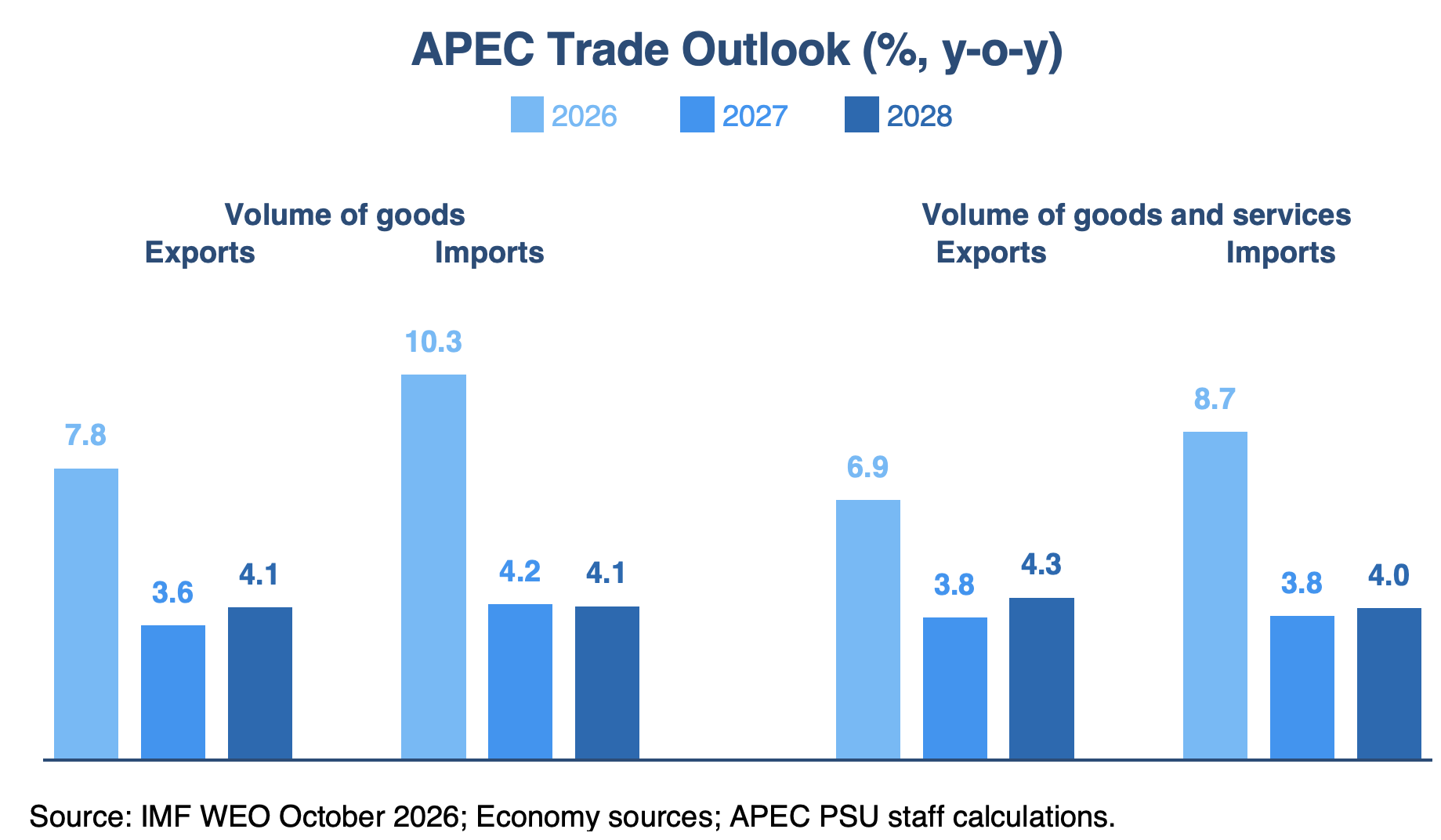
Export volumes of goods and services are projected to grow by 6.9 percent in 2026, down from 7.4 percent in 2025, before slowing further to 3.8 percent in 2027. Import volume growth is forecast at 8.7 percent in 2026, easing to 3.8 percent in 2027.
Fiscal Constraints, Limited Policy Space
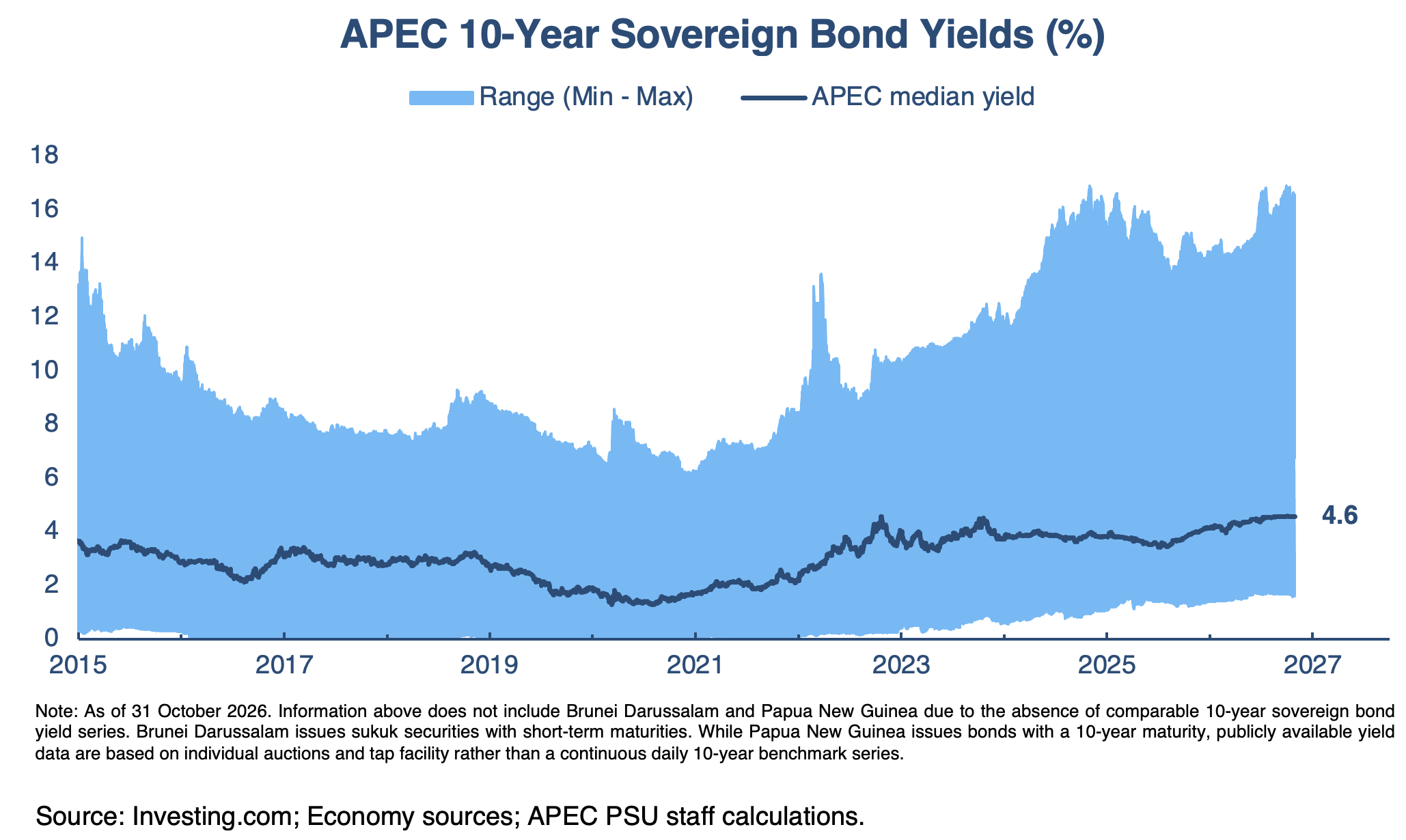
Rising borrowing costs are exacerbating economic pressures. Sovereign bond yields in APEC economies have climbed further in recent months, making it more expensive for governments and businesses to borrow.
Public debt is projected to reach 108-112 percent of GDP in the near-term, adding to the fiscal burden. Higher debt levels and interest payments could further strain governments’ finances, limiting their ability to support growth and respond to future shocks.
These fiscal strains could also weigh on medium- to long-term economic growth. As governments spend more on servicing debt, they have less room to invest in infrastructure, education, health and other priorities that underpin productivity.
Although not widespread across the region, persistent twin deficits in some economies, where fiscal and current account deficits occur at the same time, highlight vulnerabilities linked to fiscal imbalances and weak private savings to meet investment needs.
Strengthening Resilience Through Coordinated Action
The APEC region faces competing economic pressures. Investments in new and emerging technologies are creating opportunities to boost productivity and growth, but rising energy prices, geopolitical fragmentation and tighter financial conditions threaten to undermine these gains. Navigating these challenges will require action in four key policy areas.
First, implement an agile and effective policy mix. Monetary policy should focus on containing inflation and keeping inflation expectations anchored. Fiscal policy should prioritize consolidation while providing targeted, temporary support to those most affected by the rising cost of living. Strengthening revenue mobilization and maintaining disciplined spending can help steer public debt toward a more sustainable path.
Second, diversify investments and energy sources. Economies should expand investments beyond new and emerging technologies to develop a broader base of growth drivers. Diversifying energy sources can also reduce exposure to price volatility and supply disruptions, strengthening energy security amid geopolitical tensions and market uncertainties.
Third, strengthen the trading environment. Expanding trading partners, broadening the mix of exported goods and services, and securing alternative supply routes can reduce reliance on individual markets and supply chains. Keeping markets open and predictable, and minimizing unnecessary trade restrictions, can help businesses navigate uncertainty and sustain regional trade.
Fourth, fortify multilateral linkages. APEC plays a vital role in sustaining dialogue amid growing economic fragmentation, promoting open markets for critical goods and supplies, and encouraging practical cooperation on shared challenges. Closer collaboration can help economies share policy experiences, strengthen supply-chain connectivity and ensure that the gains from technological progress are more widely shared.
The region's economic outlook will depend not only on its capacity to withstand shocks, but also on how effectively it prepares for the next phase of global change.
Technology-driven investments offer a potential engine of productivity and growth, but its benefits are neither automatic nor universal. By maintaining macroeconomic stability, diversifying sources of growth, strengthening trade links and deepening regional cooperation, APEC economies can better manage near-term uncertainty while strengthening the foundations for shared prosperity.
Rhea Crisologo Hernando is analyst, Eldo Simanjuntak is researcher and Carlos Kuriyama is director at the APEC Policy Support Unit.
For more on this topic, download the latest APEC Regional Trends Analysis, November 2026.