

Reports
Advancing Economic Development in the APEC Region: Best Practices for Smart Human–Machine Collaboration in the Heavy Steel Construction Industry
The Asia-Pacific Economic Cooperation (APEC) is a regional economic forum established in 1989 to leverage the growing interdependence of the Asia-Pacific.
The Asia-Pacific Economic Cooperation (APEC) is a regional economic forum established in 1989 to leverage the growing interdependence of the Asia-Pacific.
APEC ensures that goods, services, investment and people move easily across borders. Members facilitate this trade through faster customs procedures at borders; more favorable business climates behind the border; and aligning regulations and standards across the region.
APEC ensures that goods, services, investment and people move easily across borders. Members facilitate this trade through faster customs procedures at borders; more favorable business climates behind the border; and aligning regulations and standards across the region.
APEC has helped drive economic growth and cooperation across the Asia-Pacific by reducing trade barriers, improving the ease of doing business and strengthening connectivity among economies. These efforts have contributed to rising incomes, expanded trade and greater opportunities for businesses and communities across the region.
APEC has helped drive economic growth and cooperation across the Asia-Pacific by reducing trade barriers, improving the ease of doing business and strengthening connectivity among economies. These efforts have contributed to rising incomes, expanded trade and greater opportunities for businesses and communities across the region.
APEC brings together governments, businesses and stakeholders to collaborate on shared priorities. Explore opportunities to participate in events, contribute to initiatives and engage with APEC’s work across the region.
APEC brings together governments, businesses and stakeholders to collaborate on shared priorities. Explore opportunities to participate in events, contribute to initiatives and engage with APEC’s work across the region.
Reports
•May 2020
Download Report
2MB
Published Under
APEC Secretariat, APEC Policy Support Unit
Accessed
12395
Pages
35
The waste we throw away has a tendency of coming back in our air, water and food, directly affecting our livelihoods, economy and health. The theme chapter discusses a more sustainable production model — the circular economy — which minimises waste and optimises resource use by incorporating reuse, repurposing and recycling of materials into manufacturing and logistics. It discusses new business and trade opportunities provided by the circular economy in general and during the COVID-19 pandemic. Regional cooperation has an important role to play in facilitating the transition to a circular economy.
The next chapter on economic and trade trends shows that the APEC region has been slowing down in 2019, even before the onset of the COVID-19 pandemic. The region’s GDP growth slowed down to 3.6 percent in 2019 while merchandise trade value contracted due to uncertainty arising largely from persistent trade and technology tensions. In 2020, the APEC region is expected to contract by 2.7 percent due to the economic fallout from the pandemic, equivalent to an estimated output loss of USD 2.1 trillion. Getting back on the path of economic recovery post-pandemic requires a coordinated approach that could only be achieved through regional cooperation. APEC as a region needs to bolster health systems, improve social protection, exercise prudent fiscal management, and maintain monetary stability to be able to deploy emergency measures during episodes of crisis.
Reports
Advancing Economic Development in the APEC Region: Best Practices for Smart Human–Machine Collaboration in the Heavy Steel Construction Industry
Proceedings
APEC Workshop on Shaping Digital Transformation in Accreditation
Manuals
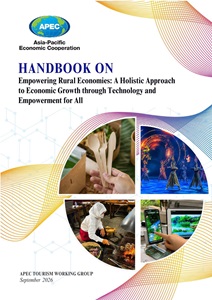
Empowering Rural Economies: A Holistic Approach to Economic Growth through Technology and Empowerment for All