

Proceedings
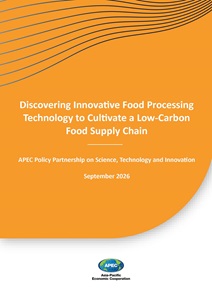
Discovering Innovative Food Processing Technology to Cultivate a Low-Carbon Food Supply Chain
The Asia-Pacific Economic Cooperation (APEC) is a regional economic forum established in 1989 to leverage the growing interdependence of the Asia-Pacific.
The Asia-Pacific Economic Cooperation (APEC) is a regional economic forum established in 1989 to leverage the growing interdependence of the Asia-Pacific.
APEC ensures that goods, services, investment and people move easily across borders. Members facilitate this trade through faster customs procedures at borders; more favorable business climates behind the border; and aligning regulations and standards across the region.
APEC ensures that goods, services, investment and people move easily across borders. Members facilitate this trade through faster customs procedures at borders; more favorable business climates behind the border; and aligning regulations and standards across the region.
APEC has helped drive economic growth and cooperation across the Asia-Pacific by reducing trade barriers, improving the ease of doing business and strengthening connectivity among economies. These efforts have contributed to rising incomes, expanded trade and greater opportunities for businesses and communities across the region.
APEC has helped drive economic growth and cooperation across the Asia-Pacific by reducing trade barriers, improving the ease of doing business and strengthening connectivity among economies. These efforts have contributed to rising incomes, expanded trade and greater opportunities for businesses and communities across the region.
APEC brings together governments, businesses and stakeholders to collaborate on shared priorities. Explore opportunities to participate in events, contribute to initiatives and engage with APEC’s work across the region.
APEC brings together governments, businesses and stakeholders to collaborate on shared priorities. Explore opportunities to participate in events, contribute to initiatives and engage with APEC’s work across the region.
Reports
•April 2020
Download Report
6MB
Published Under
Committee on Trade and Investment (CTI), Chemical Dialogue (CD)
Accessed
5256
Pages
272
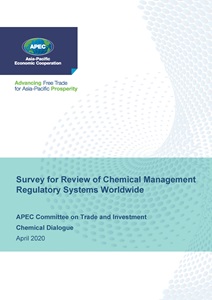
This publication contains information on the 13 chemical management systems and facts about the work of international organizations on the subject matter. Description of chemical management systems is structured in identical blocks for every economy reviewed. These blocks correspond to the main elements of the regulatory model of a chemical management system, proposed by Russia. The model was discussed and received approval within the Virtual Working Group on Regulatory Convergence of Chemical Dialogue in 2014 and Chemical Dialogue itself. The information analyzed on every economy concerned is structured under standardized blocks that simplifies comparison of different blocks in various economies. Such benchmarking enables to identify best practices and solutions in the sphere of chemical management in different chemical management frameworks and, most importantly, to approach common problems in a coherent manner.
Proceedings
Discovering Innovative Food Processing Technology to Cultivate a Low-Carbon Food Supply Chain
Proceedings
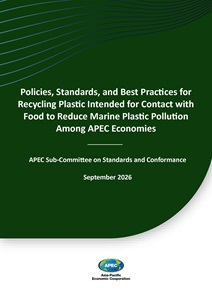
Policies, Standards, and Best Practices for Recycling Plastic Intended for Contact with Food to Reduce Marine Plastic Pollution Among APEC Economies
Reports
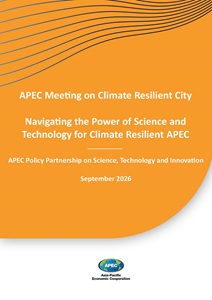
APEC Meeting on Climate Resilient City – Navigating the Power of Science and Technology for Climate Resilient APEC