Proceedings
APEC Workshop on Higher Education in Standardization
The Asia-Pacific Economic Cooperation (APEC) is a regional economic forum established in 1989 to leverage the growing interdependence of the Asia-Pacific.
The Asia-Pacific Economic Cooperation (APEC) is a regional economic forum established in 1989 to leverage the growing interdependence of the Asia-Pacific.
APEC ensures that goods, services, investment and people move easily across borders. Members facilitate this trade through faster customs procedures at borders; more favorable business climates behind the border; and aligning regulations and standards across the region.
APEC ensures that goods, services, investment and people move easily across borders. Members facilitate this trade through faster customs procedures at borders; more favorable business climates behind the border; and aligning regulations and standards across the region.
APEC has helped drive economic growth and cooperation across the Asia-Pacific by reducing trade barriers, improving the ease of doing business and strengthening connectivity among economies. These efforts have contributed to rising incomes, expanded trade and greater opportunities for businesses and communities across the region.
APEC has helped drive economic growth and cooperation across the Asia-Pacific by reducing trade barriers, improving the ease of doing business and strengthening connectivity among economies. These efforts have contributed to rising incomes, expanded trade and greater opportunities for businesses and communities across the region.
APEC brings together governments, businesses and stakeholders to collaborate on shared priorities. Explore opportunities to participate in events, contribute to initiatives and engage with APEC’s work across the region.
APEC brings together governments, businesses and stakeholders to collaborate on shared priorities. Explore opportunities to participate in events, contribute to initiatives and engage with APEC’s work across the region.
Reports
•February 2026
Download Report
5MB
Published Under
SOM Steering Committee on Economic and Technical Cooperation (SCE), Telecommunications and Information Working Group (TELWG)
Accessed
792
Pages
226
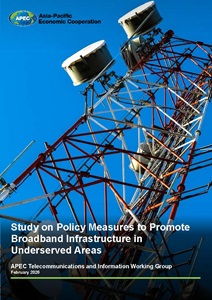
This study assesses broadband development across 21 APEC economies, focusing on bridging the digital divide in underserved areas. Utilizing a data-driven methodology, the project groups economies into four geographic clusters—large landmass, archipelagic, mountainous, and urban—to tailor policy recommendations.
Key findings reveal significant disparities in infrastructure and affordability, highlighting that regulatory reform and demand-side inclusion are as critical as physical deployment. The report analyzes successful interventions, such as Australia’s NBN and Korea’s PPP models, to identify replicable best practices.
The primary outcome is a comprehensive policy-service toolkit and a four-step decision framework designed to guide policymakers in selecting appropriate technologies and funding models. Ultimately, the publication provides an evidence-based roadmap for APEC economies to accelerate broadband adoption, ensuring equitable digital participation and sustainable economic growth.