

APEC Grows Amid a Complex Global Landscape as Economic Engines Shift

Strong macroeconomic fundamentals, technology-powered trade, and agile policy responses are helping economies navigate heightened geopolitical tensions. However, the outlook is becoming more complex.
The APEC region continues to expand despite a more challenging global environment. Strong macroeconomic fundamentals, technology-powered trade, and agile policy responses are helping economies navigate heightened geopolitical tensions. However, the outlook is becoming more complex as higher energy prices, weather-related disruptions, rising freight costs, geopolitical tensions and persistent trade policy uncertainty increasingly weigh on growth.
Growth remains resilient amid challenges
Despite heightened global uncertainty, APEC is expected to continue to grow by 3.2 percent in 2026 and 3.0 percent in 2027, although slightly lower than the 3.3 percent expansion in 2025. These forecasts are largely unchanged from the May edition of the APEC Regional Trends Analysis (ARTA), suggesting that the underlying economic fundamentals have remained broadly stable. While the near-term outlook shows a modest slowdown, the headline numbers mask important shifts.
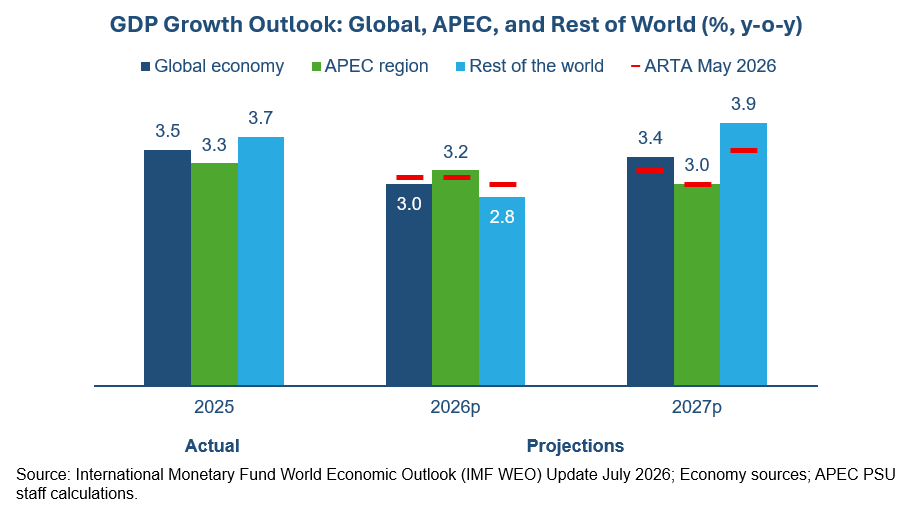 Growth is increasingly supported by technology-related trade, digital services and investment in these sectors, even as traditional sources of momentum face greater constraints. This resilience also reflects strong macroeconomic fundamentals and economies’ ability to respond to changing conditions through policy measures.
Supply chain constraints and trade policy uncertainty have eased recently, providing some relief to businesses. Yet vulnerabilities, including trade-restrictive measures, remain and continue to weigh on the outlook.
Ongoing geopolitical tensions have contributed to higher energy prices, raising production and transportation costs. These pressures are feeding into international logistics, resulting in increased freight costs across intra-Asia and extra-Asia routes. Even when physical disruptions ease, higher fuel, insurance and shipping costs can continue to affect the movement of goods and raise costs throughout supply chains. At the same time, warmer-than-normal conditions associated with El Niño could affect agricultural output, putting upward pressure on food prices.
Together, these pressures could create a more difficult environment for businesses and consumers. Higher energy, food and transportation costs can squeeze household purchasing power, raise business costs and make investment decisions more uncertain. If sustained, they could dampen consumption and investment, slowing down economic activity.
Inflation is Likely to Rise Before Easing
Price pressures are expected to translate into higher average inflation in APEC, from 2.4 percent in 2025 to 2.9 percent in 2026, before moderating to 2.5 percent in 2027.
The projected rise highlights the risk of a less favourable combination of slower growth and renewed inflationary pressures. Higher energy costs can feed directly into fuel prices and indirectly into the cost of producing and transporting goods. Weather-related disruptions could aggravate the situation, reducing agricultural production and raising food prices.
The expected easing in 2027, however, suggests that some of these pressures may prove temporary. Policymakers will therefore need to balance price stability with support for economic activity, particularly if growth momentum weakens.
Trade and Digital Services Support Regional Growth
Trade remains one of the brighter spots in the region. The expansion recorded in 2025 continued into early 2026, driven mainly by technology products. During the first quarter of 2026, merchandise exports and imports recorded double-digit growth compared to year-ago levels. The value of goods exports increased by 18.8 percent, while export volumes rose by 10.8 percent. Import values increased by 10.2 percent, while import volumes rose by 11.1 percent.
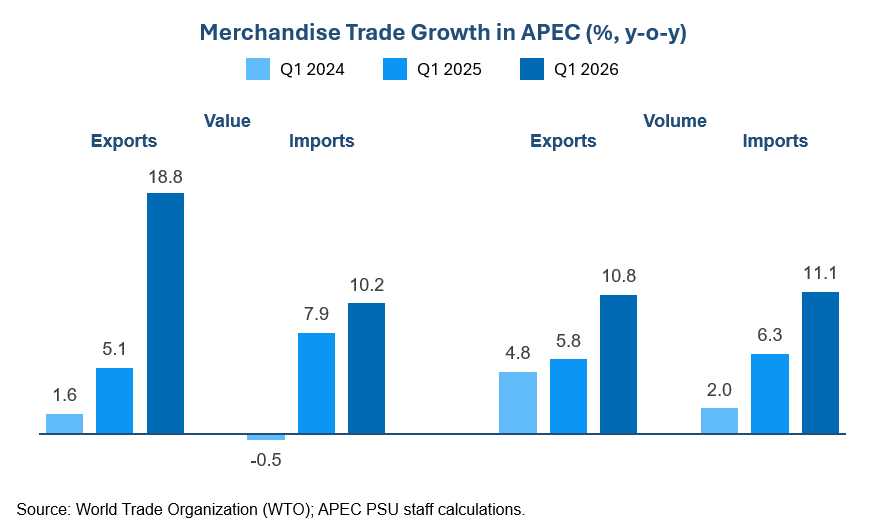
The robust trade performance points to strong underlying demand for goods, particularly those linked to technology and digitalization. Technology investment has become an important engine of regional growth, supporting demand for electronics and other technology-related products.
This strength provides a vital source of momentum, although it also highlights a potential vulnerability. When growth becomes increasingly concentrated in specific sectors, it raises exposure to changes in technology demand and investment cycles. For instance, it remains uncertain whether the massive investments in AI will deliver the expected returns. At the same time, geo-economic developments and trade policy uncertainty could cloud the outlook for technology-driven trade.
Meanwhile, the services sector continues to contribute to regional growth, particularly through the sustained expansion of digitally delivered services. Latest data for 2025 shows exports and imports of digitally delivered services reached USD1.8 trillion and USD1.5 trillion, respectively, equivalent to around 70-75 percent increase from pre-pandemic levels. This upsurge creates new opportunities for productivity and growth as digital services enable businesses to participate more fully in regional and global markets. Realizing these opportunities will depend on continued investment in digital infrastructure, connectivity and technology adoption.
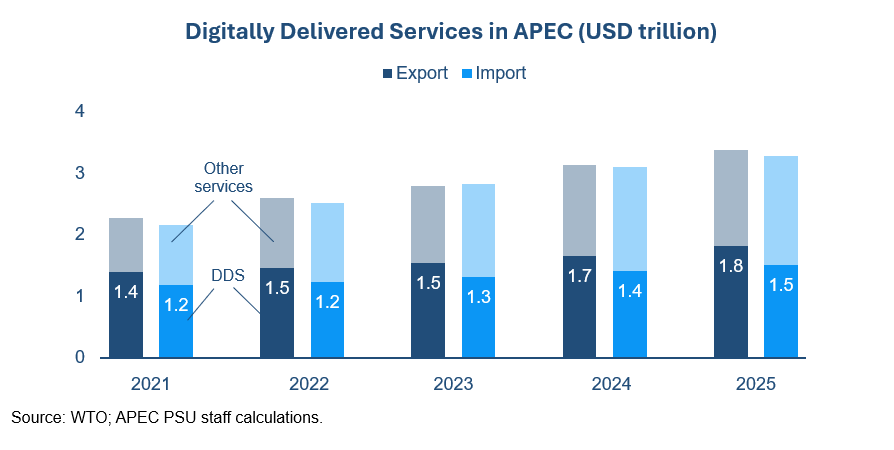
Overall commercial services trade, however, grew at a slower pace in the first quarter of 2026 as gains in travel, transport and goods-related services have moderated from previous years. Commercial services exports grew by 5.4 percent growth and imports by 6.9 percent, compared with 7.5 percent and 7.1 percent, respectively, a year ago.
Trade imbalances also persist across economies, pointing to deeper structural differences in production, competitiveness and domestic demand. Addressing these imbalances requires policies that promote more balanced and resilient growth rather than relying solely on short-term adjustments.
Investment is Shifting Toward Strategic Sectors
The investment landscape provides another indication of how the regional economy is changing.
Foreign direct investment remains broadly stable, while greenfield investment is growing. Importantly, greenfield investment is becoming more concentrated in digital services, including information and communication services, as well as electronics and energy. Together, these sectors accounted for 57.6 percent of global greenfield investments in 2025, nearly 10 percentage points higher than five years ago.
This concentration reflects the structural transformation underway in APEC economies.
Digitalization is creating demand for new infrastructure and services, while the energy sector is receiving greater attention amid changing energy needs and security considerations. Electronics, meanwhile, remain central to technology-driven production and trade. This shift could support sustained growth if accompanied by improvements in skills, infrastructure, connectivity and the broader investment environment.
Extreme Weather Adds to Economic Uncertainty
Risks to the economic outlook extend beyond trade policy uncertainty and geopolitical tensions.
Weather conditions are increasingly shaping economic performance as extreme weather events can trigger considerable negative effects on agriculture output and food prices.
The region is expected to experience an intensifying El Niño this year, with drought, heat stress and flooding potentially dampening agricultural production. So far, supplies of key agricultural products are seen to remain broadly adequate. However, there is an observed tightening in supplies of milled rice, oilseeds and vegetable oils, which could heighten risks to food security and exert upward pressure on food prices.
For economies where food represents a significant share of household spending, these developments can have important implications. Lower agricultural output can raise food prices, deplete real household incomes and increase pressure on vulnerable households. Weather-related disruptions can also affect trade flows as changes in domestic production occur. These potential scenarios highlight how weather-related shocks can spill over into the broader economy through food prices, trade and household purchasing power.
Bolstering Resilience for the Next Phase of Growth
The near-term outlook points to a regional economy that shows resilience but faces increasingly interconnected risks. Four policy priorities can help bolster economic resilience:
Accelerate digital transformation. Expanding digital infrastructure and connectivity while promoting technology adoption can help economies capture productivity gains and broaden participation in the digital economy.
Deepen supply chain resilience. Greater trade integration, open and rules-based trade, and the use of digital platforms can improve supply chain efficiency and reduce vulnerabilities.
Strengthen food security and agricultural adaptation. Investment in resilient agriculture and early warning systems, coupled with reinforced regional cooperation on disaster risk management, can help economies prepare for weather-related disruptions.
Mobilize regional investment for growth. Improving the investment environment, developing productive sectors and strengthening regional policy dialogue can support investment and longer-term productivity.
Looking Ahead
APEC faces an increasingly complex global economic and policy landscape. Growth is supported by strong trade, technology investment and digitalization, while generally stable macroeconomic fundamentals provide an important buffer against external shocks.
Yet the risks are becoming more interconnected. Geopolitical tensions can raise energy and freight costs, weather-related shocks can affect food production and inflation, and trade policy uncertainty can amplify supply chain vulnerabilities. These pressures make it critical for economies to strengthen their capacity to absorb shocks while continuing to pursue productivity-enhancing investment.
Beyond sustaining growth, APEC needs to harness digital transformation and other current sources of resilience to build a more diversified, connected and stable economy over the long term. Achieving this will require stronger regional cooperation, continued investment in infrastructure and skills, and policies that support broad-based growth and strengthen the region’s capacity to navigate future shocks.
Rhea Crisologo Hernando is analyst, Eldo Simanjuntak is researcher and Carlos Kuriyama is director at the APEC Policy Support Unit.
For more on this topic, download the latest APEC Regional Trends Analysis report.