

Hong Kong, China
•21 October 2026
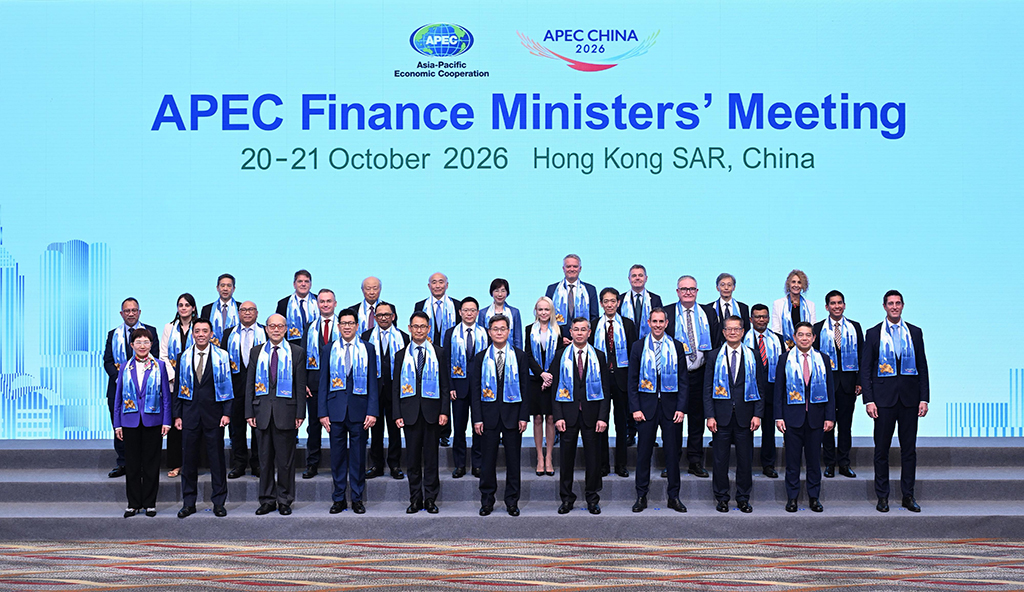
2026 APEC Finance Ministers' Meeting
2026 APEC Finance Ministers’ Joint Statement
Venue: Hong Kong, China, 21 October 2026
1. We, the APEC Finance Ministers, convened our 33rd annual meeting on October 20-21, 2026, in Hong Kong, China, chaired by H.E. Lan Fo’an, Minister of Finance of the People’s Republic of China.
2. Under the APEC 2026 theme of “Building an Asia-Pacific Community to Prosper Together”, and with a focus on the 2026 priorities of “Openness, Innovation, Cooperation”, guided by the APEC Putrajaya Vision 2040 and the Incheon Plan and noting other existing APEC frameworks, we reaffirm our commitment to building an open, dynamic, resilient, and peaceful Asia-Pacific community by 2040 for the prosperity of all our people and future generations. We engaged in meaningful discussions on fiscal policy supporting households, digital infrastructure financing, financial access and opportunity for all, and welcomed the convening of the Young Financial Talents Dialogue, to promote the prosperity and resilience of the region.
Global and Regional Economy
3. The global and regional economy has shown resilience, with rapid technological development and industrial transformation emerging as important engines of economic growth. Downside risks persist due to ongoing geoeconomic tension, supply chain vulnerabilities, commodity prices volatility, tighter financing conditions, extreme weather events and natural disasters, and continued policy uncertainty. Over the medium term, structural challenges, such as debt vulnerabilities, demographic shifts, economic fragmentation, extreme weather events and natural disasters, may continue to weigh on growth prospects. APEC economies stand together at a pivotal moment to advance collective efforts to enhance economic resilience. We note that global imbalances have persisted, creating risks to growth and stability. We recognize that global rebalancing is in our common interest and agree to strengthen communication and cooperation in this regard. We also reaffirm our commitment to maintain resilient supply chains and recognize that it is in our mutual interest that our region remains interconnected and trade corridors remain open. We also recognize the importance of transparency regarding measures that may affect trade or disrupt supply chains.
4. We emphasize the importance of credible and flexible fiscal, monetary and financial policy frameworks to manage shocks, maintain macroeconomic and financial stability, and the need for structural reforms to address medium-term vulnerabilities. We reaffirm our 2021 exchange rate commitments. We recognize the pivotal role of digital and other advanced technologies in enhancing productivity, innovation, efficiency and resilience and supporting economic growth, and underscore the importance of encouraging innovation and responsible adoption of these technologies, while promoting digital skills development and workforce adaptation to ensure that the benefits of technological progress are widely shared, and addressing potential risks and strengthening consumer and business trust.
5. We encourage strong multilateral cooperation in the APEC region as an important driver to promote economic growth. We remain committed to APEC as the premier forum for regional economic cooperation and emphasize the importance of its role in bringing us together to address economic challenges and create a more resilient and prosperous Asia-Pacific region for all.
Fiscal Policy Supporting Households
6. We take note of the structural challenges the region is facing, and underscore the importance of enhancing the effectiveness and quality of public spending. We reaffirm that well-targeted household-supporting fiscal policies—particularly through strengthening household consumption, where needed, and investing in human capital across the life cycle—can support domestic demand in the short term and enhance productivity, innovation and sustained growth over the long term. We encourage member economies, consistent with their respective domestic circumstances and fiscal space, to design and implement targeted and well-calibrated fiscal measures that strengthen the link between public expenditure and tangible improvements in household welfare, which can foster positive feedback loops between consumption, productivity, and employment.
7. In this regard, we acknowledge the Report Supporting Households and Investing in Human Capital: Fiscal Policy Considerations for Sustaining Growth in APEC, prepared by the World Bank, offered to APEC Finance Ministers as reference. We underscore the importance of strengthening household consumption, where needed, building human capital across the life cycle, ensuring spending efficiency, and promoting domestic revenue mobilization as appropriate to member economies’ diverse domestic circumstances and policy priorities. While advancing these fiscal policies supporting households, we recognize key fiscal principles, including fiscal sustainability, macroeconomic stability, and efficient resource allocation and prudent public debt management, which safeguard welfare against economic volatility and, in that way, provide an essential foundation for households and firms to invest, innovate, and prosper.
Digital Infrastructure Financing
8. We acknowledge that robust digital infrastructure serves as the backbone of economic resilience and financial stability. Yet significant financing gaps persist in some economies, exacerbated by policy and regulatory constraints and limited financing channels. We therefore encourage exchanging views and sharing best practices across APEC economies to identify and address these gaps through developing a whole-of-ecosystem approach that mobilizes resources from the public sector, the private sector, and multilateral development banks (MDBs).
9. We encourage the public sector to foster clear, transparent, and predictable policy and regulatory frameworks for digital infrastructure development. We encourage the private sector to play a prominent role in providing funding and technical expertise, and to develop and adopt innovative financing approaches. We also encourage MDBs, in line with their respective mandates, to play a catalytic role by de-risking investments including through approaches which may include guarantees and blended finance mechanisms, mobilizing private capital, and supporting project preparation and readiness. We affirm that this effort can leverage a range of finance models to bridge funding gaps and accelerate the deployment of digital infrastructure.
10. We welcome and endorse the Policy Statement on Digital Infrastructure Financing Across the Asia-Pacific Region. We recognize its value as a voluntary and non-binding document under the Finance Ministers’ Process (FMP) that contributes to a more digitally empowered Asia-Pacific region. We encourage member economies to enhance voluntary knowledge sharing on mutually acceptable terms and capacity building, consistent with their domestic circumstances and priorities.
Financial Access and Opportunity for All
11. We recognize that expanding financial access and opportunity for all contributes to balanced, sustainable growth and strengthens economic resilience, ultimately advances the long-term financial well-being of our populations. We emphasize that financial services should be available, accessible, affordable, trusted, usable, transparent, and responsive to the diverse needs of individuals, households, and businesses, particularly MSMEs. We emphasize the importance of financial consumer protection and financial literacy for all in enabling people to use financial services with confidence. We note with concern that those with limited digital or financial literacy continue to face persistent barriers in accessing and using such services.
12. We acknowledge the efforts of member economies to advance approaches to financial access and opportunity that suit their respective contexts. We acknowledge the APEC Compendium on Financial Access and Opportunity for All. We underscore the importance of sharing these experiences and good practices among member economies, and encourage economies to draw on relevant experiences as appropriate to develop approaches to financial access tailored to their domestic contexts.
Young Financial Talents Dialogue
13. We recognize that cultivating the next generation of financial policymakers and professionals has become increasingly critical to seizing emerging opportunities and addressing shared challenges. We welcome efforts for a capacity-building and knowledge-exchange dialogue for young financial officials across the APEC region. This event, themed “Digital Innovation for Development and Growth”, has been concluded in August and organized by Asia-Pacific Finance and Development Institute (AFDI).
14. We welcome the program’s summary report and commend this program for its contribution to strengthening participants’ collaboration and building young financial leaders’ network. We support in principle continuing the cooperation to enhance capacity of young professionals in the financial sector, taking into account the host year’s priorities and to be agreed through the Finance Ministers’ Process.
Other Issues
15. We appreciate the continuous support for the FMP’s work from the APEC Secretariat, the Asian Development Bank (ADB), the Inter-American Development Bank (IDB), the International Monetary Fund (IMF), the Organisation for Economic Co-operation and Development (OECD), and the World Bank Group (WBG). We also take note of the contributions from the Asian Infrastructure Investment Bank (AIIB), United Nations Development Programme (UNDP) and Development Bank of Latin America and the Caribbean (CAF). Furthermore, we welcome the active and ongoing collaboration with the private sector, in particular with the APEC Business Advisory Council (ABAC), and acknowledge ABAC’s recommendations to the APEC Finance Ministers. We note the contributions of some APEC economies and the private sector to FMP workstreams and initiatives, such as the Working Group on Regional Disaster Risk Financing and Insurance Solutions for APEC Economies (DRFI-WG), the Asia-Pacific Financial Forum (APFF), the Asia-Pacific Infrastructure Partnership (APIP), the Asia-Pacific Financial Inclusion Forum (APFIF), the Asia Region Funds Passport (ARFP), the Asia-Pacific Finance and Development Institute (AFDI) and the Sustainable Finance Initiative (SFI).
16. We express our appreciation to the People’s Republic of China for hosting the 2026 APEC Finance Ministers’ Meeting and to Hong Kong, China for the hospitality extended at this meeting. We look forward to meeting again at our 34th Finance Ministers’ Meeting in Viet Nam in 2027.