

Nanjing, People's Republic of China
•21 September 2026
Joint Statement of the 8th APEC Human Resources Development Ministerial Meeting
Joint Statement of the 8th APEC Human Resources Development Ministerial Meeting
Nanjing Statement
Modernizing Human Resources Development for A Stronger Asia-Pacific Community
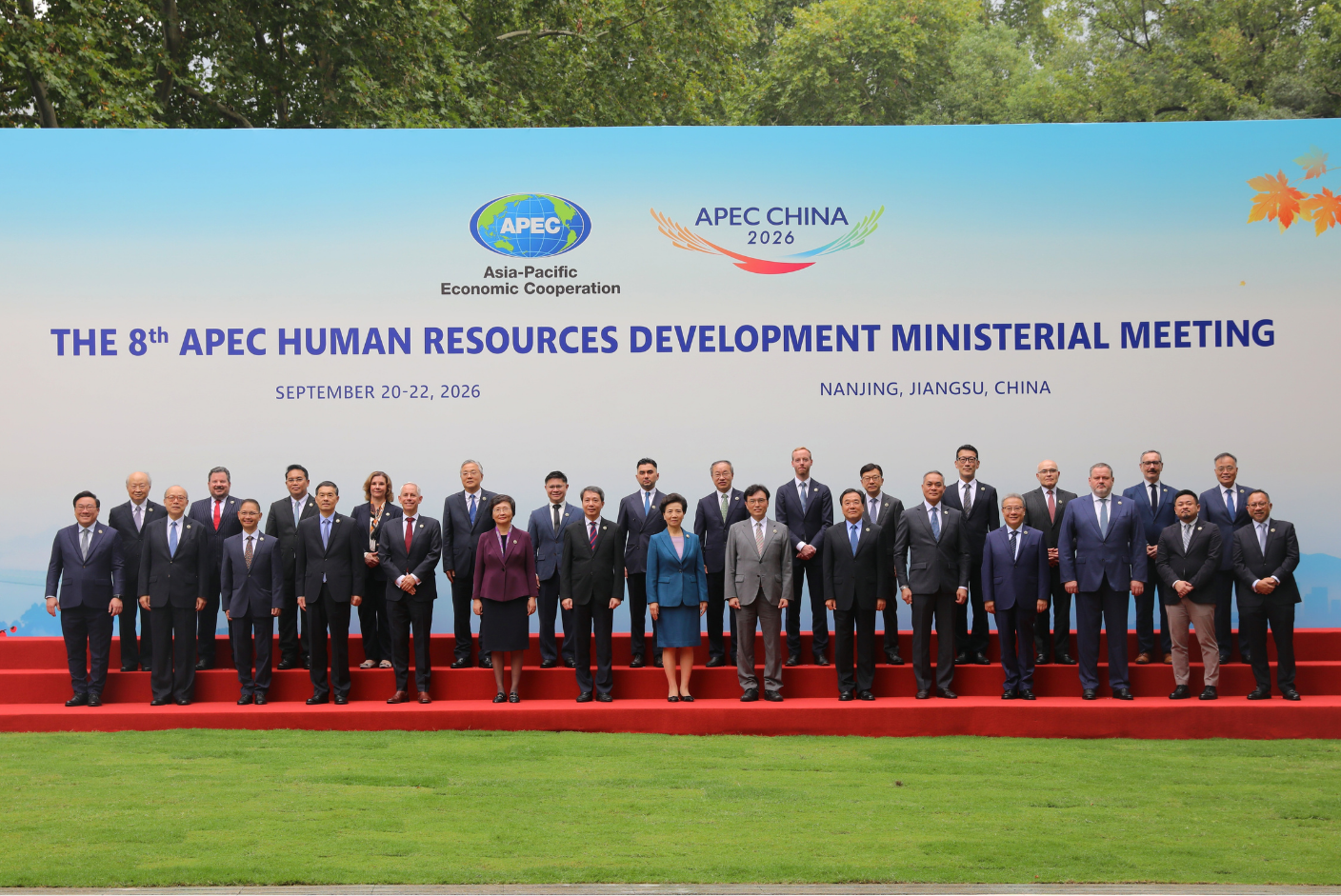
1. We, the Asia-Pacific Economic Cooperation (APEC) Ministers responsible for Human Resources Development, met in Nanjing, People’s Republic of China, on 21 September 2026 for the 8th APEC Human Resources Development Ministerial Meeting (HRDMM).
2. We convened the HRDMM under the theme of “Modernizing Human Resources Development for A Stronger Asia-Pacific Community” inspired by the APEC 2026 theme of “Building an Asia-Pacific Community to Prosper Together” and China’s three priorities of “Openness, Innovation, Cooperation”. We reaffirm our commitment to realizing an open, dynamic, resilient and peaceful Asia-Pacific community through human resources development for the prosperity of all our people and future generations guided by the APEC Putrajaya Vision 2040.
3. We recognize that developing human resources is important for economic growth. The Asia-Pacific region accounts for 40 percent of the global population and possesses abundant human capital. APEC cooperation on human resources development is long-standing and wide-ranging. At present, a new round of technological advancement and industrial transformation is taking place. Artificial Intelligence (AI) and other emerging technologies are reshaping production and employment patterns, accelerating labor market transformation and bringing far-reaching impacts to the world of work. At the same time, rapid demographic shifts are converging and driving profound changes in human resources development.
4. We emphasize the importance of responding proactively to emerging developments in the labor market, seizing new human resources development opportunities, and supporting the economic empowerment of all. We endeavor to strengthen human resources development through promoting high-quality, full, productive, and decent employment, investing in people, and strengthening and optimizing social security systems as appropriate to build a prosperous Asia-Pacific community for all.
I. Promoting High-quality, Full and Productive Employment and Employment-Friendly Economic Growth
5. Employment plays a critical role in people’s well-being and economic growth and remains central to human resources development. In the face of structural changes, such as rapid technological advancements and demographic changes, it is critical to ensure the efficiency of labor supply and demand matching while improving job quality, promoting employment opportunities and creating the conditions that lead to job growth and better employment outcomes.
6. Strengthening coherence between employment policies and other economic policies. We support emphasizing employment outcomes when formulating and evaluating domestic policies. We encourage the sharing of knowledge and best practices on economic and employment policies among member economies to strengthen capacities to respond to risks and foster thriving labor markets together.
7. Promoting pro-employment industrial systems for economic growth. We recognize the importance of whole-of-government approaches and cooperation among relevant stakeholders in supporting industrial development and employment growth. We encourage economies to harness the potential of AI and use AI in a secure, reliable, trusted, and resilient way while addressing its impacts on workers and skills demand.
8. Supporting all people in accessing employment and training opportunities. We recognize the importance of providing targeted employment assistance, reskilling and upskilling to enhance workers’ adaptability to economic transformation. We endeavor to provide access to training and employment opportunities to all with a particular focus on persons with disabilities in line with APEC existing goals and commitments to achieve economic growth.
9. Improving employment services and promoting entrepreneurship. We encourage public and private employment services which are digitalized and targeted to facilitate job matching. We welcome the private sector to engage in employment services provision to support human resources development. We support the coordination of workforce development efforts with policies that promote entrepreneurship and for micro, small and medium-sized enterprises.
10. Protecting the rights of workers. In the changing world of work, we will continue our efforts to promote international labor standards. At the same time, we are committed to strengthening labor and social protection of workers by addressing challenges domestically, including those in non-standard and new forms of employment. We endeavor to promote decent work through taking appropriate measures to enhance occupational safety and health, optimizing access to social protection and fostering working environments featuring well-being, stability, fairness, and dignity for workers.
11. Promoting the transition to the formal and global economies. We recognize the importance of human resources development in supporting the transition of workers and economic actors from the informal to the formal and global economies. We encourage economies to strengthen cooperation in this area, including, where appropriate, through education and skills development, employment services, recognition of skills, and access to social safety net programs.
II. Investing in People and Enhancing Vocational Skills Training
12. Skills training is an investment in human capital with significant returns. We will work to ensure that vocational and skills training keeps pace with industry needs and adapts to technological changes.
13. Promoting lifelong vocational skills training system and continuing education system. We encourage the sharing of good practices in lifelong learning. We seek to strengthen vocational skills training in response to labor market transformation through workplace learning and continuing education. We support work-based learning and promote quality apprenticeships in both traditional and emerging occupations. We support lifelong learning, and transitions across education, training and employment.
14. Supporting the emergence of new occupations. We highlight the importance of monitoring shifts in occupations, tasks, knowledge and skills resulting from emerging technologies to guide the development of emerging professions. We encourage the updating and revision of occupational standards and profiles while ensuring interventions do not limit labor-market transformation where is healthy for an economy and its people.
15. Strengthening digital skills training for all. We endeavor to scale up digital skills training and advance AI literacy. We encourage continued efforts to strengthen digital skills and support adaptation to technological change. We will make our efforts to leverage new technologies in the workplace, optimize the skills structure and strengthen effective use of AI in a safe, secure, reliable, trusted, and resilient digital environment.
16. Sharing experience in vocational training and continuing education. We encourage facilitating exchanges of knowledge and best practices and conducting research on skill standards, skills demonstrations and competitions, training of trainers and continuing education. We also recognize the importance of partnering with technical colleges and vocational institutions to expand opportunities of training and certification.
III. Strengthening and Optimizing Social Security Systems for Efficiency, Adaptability and Accountability
17. Social security systems play an essential role in people’s livelihoods, help provide income, reduce poverty, and serve as a stabilizer of families and communities. Strengthening and optimizing social security systems is therefore important to maintain economic growth and well-being.
18. Strengthening efficient and adaptable social security systems. We underscore the importance of social security systems accommodating diversified employment patterns in response to new forms of employment and aging population. We will continue our efforts to provide more accessible social security systems and ensure that eligible recipients can access the benefits under domestic law. We recognize the role of a reliable and economically sustainable social security systems in covering diverse risks in evolving labor markets.
19. Enhancing the resilience of social security systems. We acknowledge the importance of building actuarial capacity in social insurance and applying digital technologies in risk prevention and management to ensure the effective functioning of social security systems. We highlight the value of promoting greater coordination among social security, economic and employment policies to support economic growth.
20. Modernizing social security systems through digital technologies. While recognizing the importance of data security, protection of personal data, transparency, and appropriate human oversight in the use of AI-enabled tools, we encourage the effective and responsible adoption of emerging information technologies including big data, AI, and new technologies, where appropriate, with a view to optimizing social security systems.
21. Improving social insurance administration and service delivery. We will work towards more accessible social insurance administration while adapting to labor market demands. We welcome the efforts to develop social insurance information systems and public service platforms to provide user-friendly and secure public access to social security services.
22. Promoting regional experience sharing. We encourage policy dialogues, exchange of experts and technical cooperation projects to exchange good practices among member economies on developing social security systems and promoting cooperation on social security related affairs.
23. We commend our cooperation in human resource development guided by the APEC Putrajaya Vision 2040. We emphasize the importance of strengthening cross-fora collaboration, reviewing progress and sharing best practices through APEC Human Resource Development Working Group (HRDWG) and its Capacity Building Network (CBN), Labor and Social Protection Network (LSPN), and Education Network (EDNET) and in collaboration with Friends of the Chair for Promoting Disability Policies (FotC).
24. We express our appreciation to the People’s Republic of China for hosting this meeting and to the City of Nanjing and Jiangsu Province for their hospitality.