Proceedings
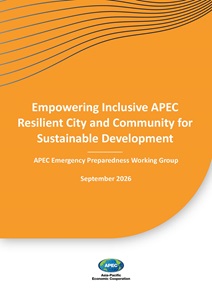
Empowering Inclusive APEC Resilient City and Community for Sustainable Development
The Asia-Pacific Economic Cooperation (APEC) is a regional economic forum established in 1989 to leverage the growing interdependence of the Asia-Pacific.
The Asia-Pacific Economic Cooperation (APEC) is a regional economic forum established in 1989 to leverage the growing interdependence of the Asia-Pacific.
APEC ensures that goods, services, investment and people move easily across borders. Members facilitate this trade through faster customs procedures at borders; more favorable business climates behind the border; and aligning regulations and standards across the region.
APEC ensures that goods, services, investment and people move easily across borders. Members facilitate this trade through faster customs procedures at borders; more favorable business climates behind the border; and aligning regulations and standards across the region.
APEC has helped drive economic growth and cooperation across the Asia-Pacific by reducing trade barriers, improving the ease of doing business and strengthening connectivity among economies. These efforts have contributed to rising incomes, expanded trade and greater opportunities for businesses and communities across the region.
APEC has helped drive economic growth and cooperation across the Asia-Pacific by reducing trade barriers, improving the ease of doing business and strengthening connectivity among economies. These efforts have contributed to rising incomes, expanded trade and greater opportunities for businesses and communities across the region.
APEC brings together governments, businesses and stakeholders to collaborate on shared priorities. Explore opportunities to participate in events, contribute to initiatives and engage with APEC’s work across the region.
APEC brings together governments, businesses and stakeholders to collaborate on shared priorities. Explore opportunities to participate in events, contribute to initiatives and engage with APEC’s work across the region.
Proceedings
•March 1998
Download Report
1MB
Published Under
SOM Steering Committee on Economic and Technical Cooperation (SCE), Policy Partnership on Science, Technology and Innovation (PPSTI)
Accessed
15302
Pages
271
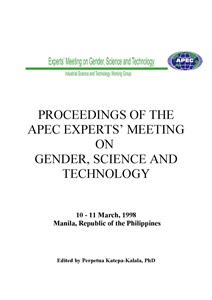
[Out of Print] The two-day meeting focused on gender disaggregated data on science and technology. Special emphasis was placed on that data which is required for the formulation of policies and strategies to promote gender balance in scientific and technological education and careers. This report presents summaries of the key note address, the panel presentations, as well as the salient points arising from subsequent discussions. It ends with a listing of the recommendations from the six discussion groups.