

Reports
2025 Progress Review on Food Loss and Waste Reduction in the Asia-Pacific Economic Cooperation Region
The Asia-Pacific Economic Cooperation (APEC) is a regional economic forum established in 1989 to leverage the growing interdependence of the Asia-Pacific.
The Asia-Pacific Economic Cooperation (APEC) is a regional economic forum established in 1989 to leverage the growing interdependence of the Asia-Pacific.
APEC ensures that goods, services, investment and people move easily across borders. Members facilitate this trade through faster customs procedures at borders; more favorable business climates behind the border; and aligning regulations and standards across the region.
APEC ensures that goods, services, investment and people move easily across borders. Members facilitate this trade through faster customs procedures at borders; more favorable business climates behind the border; and aligning regulations and standards across the region.
APEC has helped drive economic growth and cooperation across the Asia-Pacific by reducing trade barriers, improving the ease of doing business and strengthening connectivity among economies. These efforts have contributed to rising incomes, expanded trade and greater opportunities for businesses and communities across the region.
APEC has helped drive economic growth and cooperation across the Asia-Pacific by reducing trade barriers, improving the ease of doing business and strengthening connectivity among economies. These efforts have contributed to rising incomes, expanded trade and greater opportunities for businesses and communities across the region.
APEC brings together governments, businesses and stakeholders to collaborate on shared priorities. Explore opportunities to participate in events, contribute to initiatives and engage with APEC’s work across the region.
APEC brings together governments, businesses and stakeholders to collaborate on shared priorities. Explore opportunities to participate in events, contribute to initiatives and engage with APEC’s work across the region.
Reports
•September 2026
Download Report
911KB
Published Under
SOM Steering Committee on Economic and Technical Cooperation (SCE), Ocean and Fisheries Working Group (OFWG)
Accessed
236
Pages
28
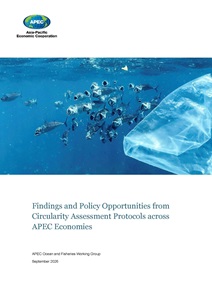
This report presents findings and policy opportunities from Circularity Assessment Protocols (CAPs) in 25 cities in seven APEC economies, including Chile; Indonesia; Malaysia; the Philippines; Thailand; United States; and Viet Nam, by the University of Georgia's Circularity Informatics Lab. Using standardized, community-level data, the CAP serves as a qualitative and quantitative baseline across seven spokes: brand input, community perspectives, product design, use and reuse, collection infrastructure, end of cycle material management, and environmental leakage. Key findings highlight that single-use plastics dominate packaging and food service across most economies, reuse and refill infrastructure remains nascent, and tobacco products and food-related plastics are the most prevalent litter categories. The report identifies actionable policy opportunities to advance circular economy goals including extended producer responsibility, source segregation, and composting expansion. APEC leadership can amplify community-led circularity efforts by sharing knowledge across economies, supporting local governments, and driving coordinated policy action to scale solutions.
Reports
2025 Progress Review on Food Loss and Waste Reduction in the Asia-Pacific Economic Cooperation Region
Proceedings
Workshop on Collaboration Mechanism among APEC Economies to Link Local Development with Disaster Risk Reduction Measures Intensified by Climate Change
Proceedings
Empowering Inclusive APEC Resilient City and Community for Sustainable Development