Proceedings
APEC Workshop on Higher Education in Standardization
The Asia-Pacific Economic Cooperation (APEC) is a regional economic forum established in 1989 to leverage the growing interdependence of the Asia-Pacific.
The Asia-Pacific Economic Cooperation (APEC) is a regional economic forum established in 1989 to leverage the growing interdependence of the Asia-Pacific.
APEC ensures that goods, services, investment and people move easily across borders. Members facilitate this trade through faster customs procedures at borders; more favorable business climates behind the border; and aligning regulations and standards across the region.
APEC ensures that goods, services, investment and people move easily across borders. Members facilitate this trade through faster customs procedures at borders; more favorable business climates behind the border; and aligning regulations and standards across the region.
APEC has helped drive economic growth and cooperation across the Asia-Pacific by reducing trade barriers, improving the ease of doing business and strengthening connectivity among economies. These efforts have contributed to rising incomes, expanded trade and greater opportunities for businesses and communities across the region.
APEC has helped drive economic growth and cooperation across the Asia-Pacific by reducing trade barriers, improving the ease of doing business and strengthening connectivity among economies. These efforts have contributed to rising incomes, expanded trade and greater opportunities for businesses and communities across the region.
APEC brings together governments, businesses and stakeholders to collaborate on shared priorities. Explore opportunities to participate in events, contribute to initiatives and engage with APEC’s work across the region.
APEC brings together governments, businesses and stakeholders to collaborate on shared priorities. Explore opportunities to participate in events, contribute to initiatives and engage with APEC’s work across the region.
Reports
•June 2025
Download Report
912KB
Published Under
APEC Secretariat, APEC Policy Support Unit
Accessed
1755
Pages
13
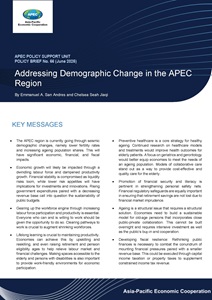
The APEC region is going through seismic demographic changes which will impact economic growth, financial stability, and fiscal budgets. A shrinking labour force and slower productivity growth will hinder economic performance, while emerging liquidity risks and lower risk appetites will affect investment and innovation. At the same time, public finances are under pressure with higher government spending combined with shrinking revenue bases.
This policy brief explores these effects in detail with accompanying projections and empirical data for the APEC region. It recommends a multi-pronged approach to mitigate the adverse effects of demographic change. Policy options include expanding, extending, and augmenting the workforce; ensuring longer and healthier lives; promoting financial security; and rethinking public finances. These steps are critical for economies to mitigate the far-reaching impacts of demographic change and ensure that past successes of healthy lives, better education, and growing affluence are maintained.