

Reports
Advancing Economic Development in the APEC Region: Best Practices for Smart Human–Machine Collaboration in the Heavy Steel Construction Industry
The Asia-Pacific Economic Cooperation (APEC) is a regional economic forum established in 1989 to leverage the growing interdependence of the Asia-Pacific.
The Asia-Pacific Economic Cooperation (APEC) is a regional economic forum established in 1989 to leverage the growing interdependence of the Asia-Pacific.
APEC ensures that goods, services, investment and people move easily across borders. Members facilitate this trade through faster customs procedures at borders; more favorable business climates behind the border; and aligning regulations and standards across the region.
APEC ensures that goods, services, investment and people move easily across borders. Members facilitate this trade through faster customs procedures at borders; more favorable business climates behind the border; and aligning regulations and standards across the region.
APEC has helped drive economic growth and cooperation across the Asia-Pacific by reducing trade barriers, improving the ease of doing business and strengthening connectivity among economies. These efforts have contributed to rising incomes, expanded trade and greater opportunities for businesses and communities across the region.
APEC has helped drive economic growth and cooperation across the Asia-Pacific by reducing trade barriers, improving the ease of doing business and strengthening connectivity among economies. These efforts have contributed to rising incomes, expanded trade and greater opportunities for businesses and communities across the region.
APEC brings together governments, businesses and stakeholders to collaborate on shared priorities. Explore opportunities to participate in events, contribute to initiatives and engage with APEC’s work across the region.
APEC brings together governments, businesses and stakeholders to collaborate on shared priorities. Explore opportunities to participate in events, contribute to initiatives and engage with APEC’s work across the region.

Proceedings
•May 2025
Download Report
2MB
Published Under
SOM Steering Committee on Economic and Technical Cooperation (SCE), Policy Partnership on Science, Technology and Innovation (PPSTI)
Accessed
727
Pages
80
This report examines strategies to establish Science, Technology, and Innovation Policies (STP) and Technology and Innovation Management (TIM) frameworks that facilitate technology transfer within APEC economies. Based on a comprehensive study and a workshop held in Lima (14-15 August 2024), it identifies best practices to promote innovation and technology transfer among public and private sectors, academia, and industry.
Key recommendations include harmonizing regulatory frameworks, increasing R&D funding in areas such as artificial intelligence, biotechnology, and clean energy, strengthening collaboration through dialogue platforms, promoting talent mobility, and supporting SMEs. The report also highlights strategies such as tax incentives, public-private partnerships, and digital innovation hubs.
The report serves as a practical guide to enhance innovation ecosystems, boost regional competitiveness, and facilitate effective technology transfer across APEC economies. It provides valuable insights and actionable recommendations for stakeholders to strengthen innovation policies and foster sustainable development.
Reports
Advancing Economic Development in the APEC Region: Best Practices for Smart Human–Machine Collaboration in the Heavy Steel Construction Industry
Proceedings
APEC Workshop on Shaping Digital Transformation in Accreditation
Manuals
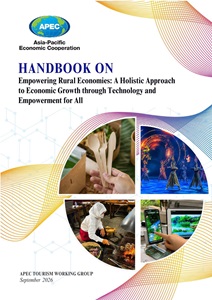
Empowering Rural Economies: A Holistic Approach to Economic Growth through Technology and Empowerment for All