Reports
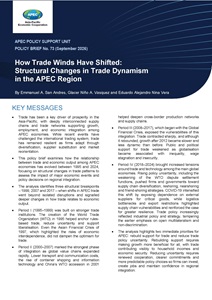
How Trade Winds Have Shifted: Structural Changes in Trade Dynamism in the APEC Region
The Asia-Pacific Economic Cooperation (APEC) is a regional economic forum established in 1989 to leverage the growing interdependence of the Asia-Pacific.
The Asia-Pacific Economic Cooperation (APEC) is a regional economic forum established in 1989 to leverage the growing interdependence of the Asia-Pacific.
APEC ensures that goods, services, investment and people move easily across borders. Members facilitate this trade through faster customs procedures at borders; more favorable business climates behind the border; and aligning regulations and standards across the region.
APEC ensures that goods, services, investment and people move easily across borders. Members facilitate this trade through faster customs procedures at borders; more favorable business climates behind the border; and aligning regulations and standards across the region.
APEC has helped drive economic growth and cooperation across the Asia-Pacific by reducing trade barriers, improving the ease of doing business and strengthening connectivity among economies. These efforts have contributed to rising incomes, expanded trade and greater opportunities for businesses and communities across the region.
APEC has helped drive economic growth and cooperation across the Asia-Pacific by reducing trade barriers, improving the ease of doing business and strengthening connectivity among economies. These efforts have contributed to rising incomes, expanded trade and greater opportunities for businesses and communities across the region.
APEC brings together governments, businesses and stakeholders to collaborate on shared priorities. Explore opportunities to participate in events, contribute to initiatives and engage with APEC’s work across the region.
APEC brings together governments, businesses and stakeholders to collaborate on shared priorities. Explore opportunities to participate in events, contribute to initiatives and engage with APEC’s work across the region.
Reports
•October 2024
Download Report
14MB
Published Under
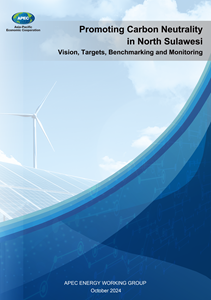
SOM Steering Committee on Economic and Technical Cooperation (SCE), Energy Working Group (EWG)
Accessed
911
Pages
208
This report shows how a Multistakeholder-Dialogue (MSD) was used to promote carbon neutrality in Indonesia’s North Sulawesi Province: Elaborating a long-term carbon neutrality vision, including on how to improve local disaster resilience, and setting three 2030 targets for energy intensity, carbon intensity and the renewables share. The MSD combines deep outreach into local communities with use of advanced global science. The target setting was facilitated by long-term global scenarios describing the dynamic background comprising global population, energy, emissions, and GDP, all impacting upon and benchmarking local communities. Monitoring renewable energy generation has been separated into local generation, distant generation, its impact on energy security and energy efficiency, and the relation to the green sector economy and green finance. The report makes seven specific recommendations applicable to cities, provinces or local communities wishing to become carbon neutral.