

Reports
Advancing Economic Development in the APEC Region: Best Practices for Smart Human–Machine Collaboration in the Heavy Steel Construction Industry
The Asia-Pacific Economic Cooperation (APEC) is a regional economic forum established in 1989 to leverage the growing interdependence of the Asia-Pacific.
The Asia-Pacific Economic Cooperation (APEC) is a regional economic forum established in 1989 to leverage the growing interdependence of the Asia-Pacific.
APEC ensures that goods, services, investment and people move easily across borders. Members facilitate this trade through faster customs procedures at borders; more favorable business climates behind the border; and aligning regulations and standards across the region.
APEC ensures that goods, services, investment and people move easily across borders. Members facilitate this trade through faster customs procedures at borders; more favorable business climates behind the border; and aligning regulations and standards across the region.
APEC has helped drive economic growth and cooperation across the Asia-Pacific by reducing trade barriers, improving the ease of doing business and strengthening connectivity among economies. These efforts have contributed to rising incomes, expanded trade and greater opportunities for businesses and communities across the region.
APEC has helped drive economic growth and cooperation across the Asia-Pacific by reducing trade barriers, improving the ease of doing business and strengthening connectivity among economies. These efforts have contributed to rising incomes, expanded trade and greater opportunities for businesses and communities across the region.
APEC brings together governments, businesses and stakeholders to collaborate on shared priorities. Explore opportunities to participate in events, contribute to initiatives and engage with APEC’s work across the region.
APEC brings together governments, businesses and stakeholders to collaborate on shared priorities. Explore opportunities to participate in events, contribute to initiatives and engage with APEC’s work across the region.
Reports
•October 2024
Download Report
3MB
Published Under
SOM Steering Committee on Economic and Technical Cooperation (SCE), Experts Group on Illegal Logging and Associated Trade (EGILAT)
Accessed
1599
Pages
115
The Project of Developing Integrated Timber Data to Enhance Legal Timber Trade of the APEC through Xylaria Networking was approved on 3 February 2023 by the Sponsoring Forum of APEC Experts Group on Illegal Logging and Associated Trade (EGILAT) under the committee of SOM Steering Committee on Economic and Technical Cooperation (SCE). With the proposition, the Project aims to address illegal logging and illicit timber trade in Asia and the Pacific region through the use of forensic wood identification techniques and the development of Xylaria Networking. Although the Project confronted many hurdles, successful completion with defined deliverables was achieved in due course. With the proposition, on this occasion, the Project Management Team, assisted by the consultant, is delighted to present a project completion report, which was open-published on the APEC Secretariat repository.
The report is the embodiment of the full summary of the interventions to accomplish outcomes and objectives as stipulated in the Project Strategic Results Framework or Theory of Changes. The report portrays the ramifications of varied interventions of the Project, including three pivotal events and a research-based activity. Three events were successfully conducted, including a joint-research discussion (JRD) on Xylaria Networking, a focus discussion group (FGD) on Xylaria Networking, and a workshop on wood identification technologies, while a research-based activity was derived from the results of these two workshops (JRD and FGD) complemented with a systematic review and survey. All the results of these activities are offered respectfully in the report. Besides the above interventions, the Project Management Team (PMT) also developed templates of agreement documents, such as Letter of Agreement (LOA), Letter of Intent (LOI), Memorandum of Understanding (MOU), Plan of Operation (POO), and Material Transfer Agreement (MTA) for Indonesia as the Receipt and the Provider, used to support the development of Xylarium Networking. The template development is well-elucidated in the report, and its examples are also annexed.
Reports
Advancing Economic Development in the APEC Region: Best Practices for Smart Human–Machine Collaboration in the Heavy Steel Construction Industry
Proceedings
APEC Workshop on Shaping Digital Transformation in Accreditation
Manuals
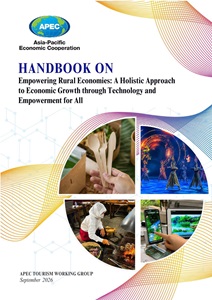
Empowering Rural Economies: A Holistic Approach to Economic Growth through Technology and Empowerment for All