Proceedings
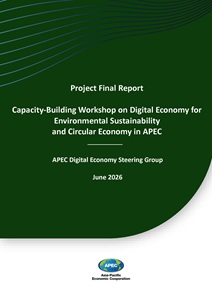
Project Final Report: Capacity-Building Workshop on Digital Economy for Environmental Sustainability and Circular Economy in APEC
The Asia-Pacific Economic Cooperation (APEC) is a regional economic forum established in 1989 to leverage the growing interdependence of the Asia-Pacific.
The Asia-Pacific Economic Cooperation (APEC) is a regional economic forum established in 1989 to leverage the growing interdependence of the Asia-Pacific.
APEC ensures that goods, services, investment and people move easily across borders. Members facilitate this trade through faster customs procedures at borders; more favorable business climates behind the border; and aligning regulations and standards across the region.
APEC ensures that goods, services, investment and people move easily across borders. Members facilitate this trade through faster customs procedures at borders; more favorable business climates behind the border; and aligning regulations and standards across the region.
APEC has helped drive economic growth and cooperation across the Asia-Pacific by reducing trade barriers, improving the ease of doing business and strengthening connectivity among economies. These efforts have contributed to rising incomes, expanded trade and greater opportunities for businesses and communities across the region.
APEC has helped drive economic growth and cooperation across the Asia-Pacific by reducing trade barriers, improving the ease of doing business and strengthening connectivity among economies. These efforts have contributed to rising incomes, expanded trade and greater opportunities for businesses and communities across the region.
APEC brings together governments, businesses and stakeholders to collaborate on shared priorities. Explore opportunities to participate in events, contribute to initiatives and engage with APEC’s work across the region.
APEC brings together governments, businesses and stakeholders to collaborate on shared priorities. Explore opportunities to participate in events, contribute to initiatives and engage with APEC’s work across the region.
Manuals
•June 2010
Download Report
3MB
Published Under
CTI Sub-Fora & Industry Dialogues Groups, Sub-Committee on Standards and Conformance (SCSC)
Accessed
200384
Pages
288
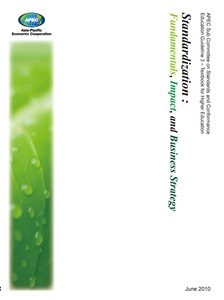
The objective of this third guideline, ‘Standardization: Fundamentals, Impacts, and Business Strategy’, is to provide a common reference textbook on standardization for the graduate program in higher education in the APEC region.
Printed copies are available for purchase now.
Part I. Fundamentals
Chapter 1 Definitions and Functions
Chapter 2 Lifecycles, Organizations, and Development Procedures
Chapter 3 Conformity Assessment
PART II. IMPACTS
Chapter 4 Economic Impacts - Macro Perspective
Chapter 5 Economic Impacts - Micro Perspective
Chapter 6 Legal Impacts
PART III. BUSINESS STRATEGY
Chapter 7 Standardization and Innovation
Chapter 8 Competitive Strategy
Chapter 9 Collaborative Strategy
Chapter 10 Two Case Studies of ICT Standard
ANNEXES