

Reports
Collaborative Development of Knowledge Discovery Approaches for Spatio-Temporal Prediction of Dry Spell to Predict Water Deficit Risk
The Asia-Pacific Economic Cooperation (APEC) is a regional economic forum established in 1989 to leverage the growing interdependence of the Asia-Pacific.
The Asia-Pacific Economic Cooperation (APEC) is a regional economic forum established in 1989 to leverage the growing interdependence of the Asia-Pacific.
APEC ensures that goods, services, investment and people move easily across borders. Members facilitate this trade through faster customs procedures at borders; more favorable business climates behind the border; and aligning regulations and standards across the region.
APEC ensures that goods, services, investment and people move easily across borders. Members facilitate this trade through faster customs procedures at borders; more favorable business climates behind the border; and aligning regulations and standards across the region.
APEC has helped drive economic growth and cooperation across the Asia-Pacific by reducing trade barriers, improving the ease of doing business and strengthening connectivity among economies. These efforts have contributed to rising incomes, expanded trade and greater opportunities for businesses and communities across the region.
APEC has helped drive economic growth and cooperation across the Asia-Pacific by reducing trade barriers, improving the ease of doing business and strengthening connectivity among economies. These efforts have contributed to rising incomes, expanded trade and greater opportunities for businesses and communities across the region.
APEC brings together governments, businesses and stakeholders to collaborate on shared priorities. Explore opportunities to participate in events, contribute to initiatives and engage with APEC’s work across the region.
APEC brings together governments, businesses and stakeholders to collaborate on shared priorities. Explore opportunities to participate in events, contribute to initiatives and engage with APEC’s work across the region.
Reports
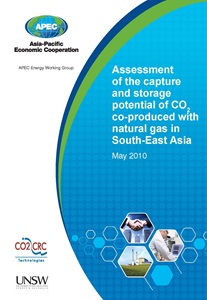
•May 2010
Download Report
2MB
Published Under
SOM Steering Committee on Economic and Technical Cooperation (SCE), Energy Working Group (EWG)
Accessed
20001
Pages
120
The aims of this report as set out in the terms of reference for the study are as follows -
(a) “to assess the techno-economic feasibility of reducing CO2 emissions resulting from natural gas production in South-East Asia through the application of CCS technologies, specifically by re-injecting the gas into subsurface geological formations” and
(b) “a combination of promoting awareness, building capacity and developing human capital in the discovery of CCS.”
Reports
Collaborative Development of Knowledge Discovery Approaches for Spatio-Temporal Prediction of Dry Spell to Predict Water Deficit Risk
Manuals
APEC Guidebook on Early Detection of Diseases Affecting Tilapia and Rainbow Trout
Proceedings
Discovering Innovative Food Processing Technology to Cultivate a Low-Carbon Food Supply Chain