Proceedings
Empowering Inclusive APEC Resilient City and Community for Sustainable Development
The Asia-Pacific Economic Cooperation (APEC) is a regional economic forum established in 1989 to leverage the growing interdependence of the Asia-Pacific.
The Asia-Pacific Economic Cooperation (APEC) is a regional economic forum established in 1989 to leverage the growing interdependence of the Asia-Pacific.
APEC ensures that goods, services, investment and people move easily across borders. Members facilitate this trade through faster customs procedures at borders; more favorable business climates behind the border; and aligning regulations and standards across the region.
APEC ensures that goods, services, investment and people move easily across borders. Members facilitate this trade through faster customs procedures at borders; more favorable business climates behind the border; and aligning regulations and standards across the region.
APEC has helped drive economic growth and cooperation across the Asia-Pacific by reducing trade barriers, improving the ease of doing business and strengthening connectivity among economies. These efforts have contributed to rising incomes, expanded trade and greater opportunities for businesses and communities across the region.
APEC has helped drive economic growth and cooperation across the Asia-Pacific by reducing trade barriers, improving the ease of doing business and strengthening connectivity among economies. These efforts have contributed to rising incomes, expanded trade and greater opportunities for businesses and communities across the region.
APEC brings together governments, businesses and stakeholders to collaborate on shared priorities. Explore opportunities to participate in events, contribute to initiatives and engage with APEC’s work across the region.
APEC brings together governments, businesses and stakeholders to collaborate on shared priorities. Explore opportunities to participate in events, contribute to initiatives and engage with APEC’s work across the region.
Manuals
•December 2009
Download Report
14MB
Published Under
SOM Steering Committee on Economic and Technical Cooperation (SCE), Tourism Working Group (TWG)
Accessed
30029
Pages
112
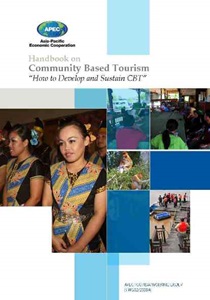
The Handbook on Community Based Tourism: “How to Develop and Sustain CBT” is designed to provide guidance for tourism/rural planners, NGOs, industry players and CBT organisations in deciding whether tourism could work for a particular community and if it is feasible, how to participate in the tourism industry and sustain it over
the long term. The handbook recommends a step by step approach in which each step is supported by a list of actions. Although it is recognised that one size does not fit all, this handbook can be adapted by communities at various stages of tourism development.
PART 1 : BASIC GUIDE
The Approach to Community Based Tourism
1. Introduction to Community Based Tourism
2. What is Community Based Tourism?
3. The Purpose of this Handbook
4. How To Use This Handbook
PART 2 : STEP BY STEP APPROACH
How to Develop and Sustain Community Based Tourism
Conclusion
Appendix
References