

Business Leaders Call for Urgent Action to Restore Trade Stability and Growth Across the Asia-Pacific
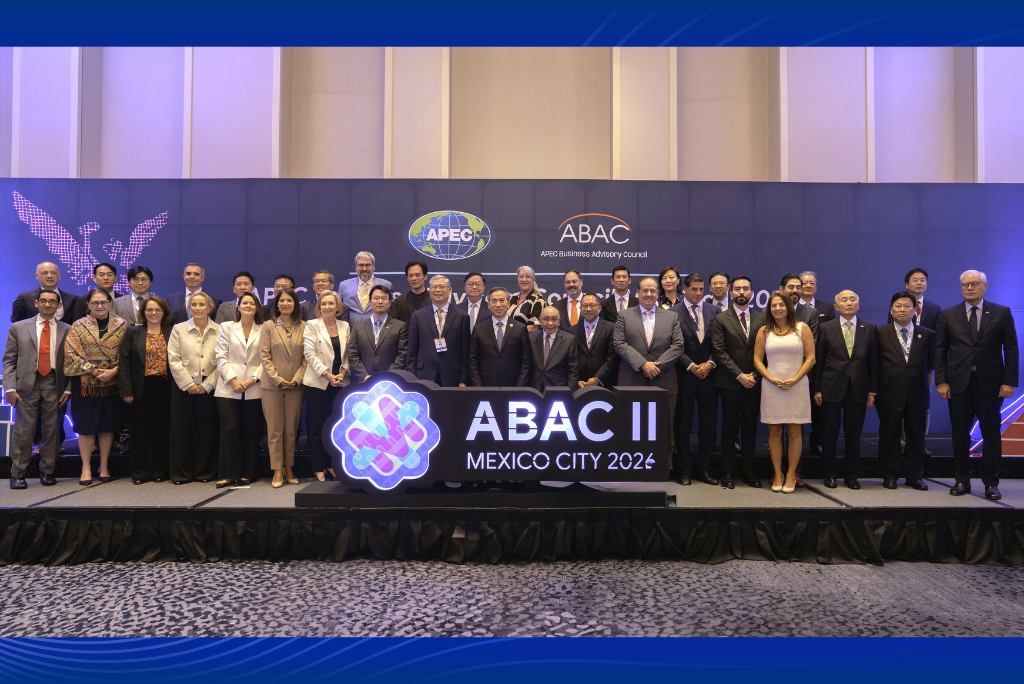
The APEC Business Advisory Council (ABAC), representing the region’s large, diverse and dynamic business community, convened its Second Meeting for 2026 in Mexico City from 22 to 25 April with a clear and urgent message: the global trade and investment environment is under acute stress, and bold, coordinated action is needed to restore confidence, resilience and long-term prosperity across the Asia-Pacific.
ABAC members expressed deep concern over mounting pressures on the global economy, including severe shocks to energy markets, persistent supply chain disruptions, rising trade and investment restrictions, intensifying environmental challenges and looming threats to food security. These are compounded by slowing growth projections across several APEC economies, inflationary pressures and continued uncertainty in global trade governance.
“We are at a critical inflection point,” said ABAC Chair Li Fanrong. “Business confidence is being tested by uncertainty on multiple fronts, from trade fragmentation to supply chain disruptions. What we need now is decisive, collective action to restore predictability and stability, and set a clear path toward sustainable growth.”
ABAC emphasized that the stakes for jobs, living standards and long-term prosperity have never been higher, with the greatest risks falling on micro and small enterprises, women entrepreneurs and vulnerable communities.
Call for Immediate Action
As a first step, ABAC called on APEC trade ministers to consider a standstill on new trade restrictions to reduce uncertainty and prevent further cost escalation for businesses operating across borders.
Priority Actions
ABAC outlined a set of priority actions aimed at restoring growth momentum and strengthening the foundations of regional economic cooperation:
- Accelerate FTAAP progress by prioritizing practical, high-impact short-term deliverables alongside convergence in trade rules architecture to build momentum toward an open regional trade environment.
- Strengthen connectivity and supply chain resilience by addressing vulnerabilities, ensuring responsible mineral sourcing, facilitating legitimate trade and enhancing transparency and sustainability.
- Invest in trade and logistics infrastructure and reduce barriers to maritime and air transport, including expanding regional and secondary-city connectivity to support mobility, trade, and investment.
- Promote market diversification by improving access to market intelligence, trade tools and capacity-building, especially for MSMEs entering new markets.
- Address non-tariff barriers in food trade by applying APEC principles on NTMs and promoting science-based, transparent measures to reduce the compliance burden on food businesses, strengthen food security and sustainability.
- Advance digital trade and transformation by establishing a permanent ban on tariffs for digital products, along with enabling universal paperless trade via the new APEC Centre of Excellence for Paperless Trade, fostering interoperable regulations, promoting responsible AI, combating online fraud and supporting quantum technology governance and literacy.
- Enhance women’s economic empowerment by removing structural barriers, advancing equal pay, increasing leadership opportunities and strengthening the care economy as essential economic infrastructure.
ABAC will convey these recommendations to Ministers Responsible for Trade who will be meeting in May. ABAC will also send a letter to the Women and the Economy Forum which contains its recommendations to enhance women’s economic empowerment.
To further highlight these recommendations, ABAC released a Statement on FTAAP urging faster progress in priority trade areas and a Statement on Connectivity calling for renewed commitment to APEC’s Connectivity Blueprint while advancing its next phase.
“ABAC’s role is to ensure that the voice of business remains central to APEC’s work,” Li Fanrong concluded. We will continue to work with Leaders and Ministers to ensure that policy keeps pace with the realities businesses are facing on the ground.”
These recommendations are in furtherance of ABAC’s theme “Openness, Synergy, Connectivity.”
“Openness, synergy and connectivity are not abstract concepts, they are practical imperatives,” Li Fanrong emphasized. “Open markets drive growth, connectivity strengthens resilience and synergy ensures that our collective efforts deliver outcomes greater than the sum of their parts.”
Engagement with APEC and Stakeholders
The meeting also featured high-level exchanges with government, APEC officials and the local business community.
The Undersecretary of Foreign Trade of the Ministry of Economy of Mexico, Luis Rosendo Gutierrez, delivered the keynote address. Side events on digital trade policy and on the role of the business community were held as Mexico prepares for hosting APEC in 2028.
China Council for the Promotion of International Trade (CCPIT) and APEC CEO Summit Chair Ren Hongbin also gave a briefing on the preparations for the APEC CEO Summit 2026, the Asia-Pacific’s premier business event which brings together top business executives to engage with Leaders and Ministers.
ABAC expressed its appreciation to ABAC Mexico for hosting a productive meeting.
The council will continue its work at its third meeting in 2026, to be held in Bangkok where it will further refine its recommendations for presentation to APEC Leaders.
For further information please contact:
Shan Ming (Mr), ABAC Executive Director 2026, at +86 10 88075807, or shanming@ccpit.org
Antonio Basilio (Mr), Director, ABAC Secretariat, at +63 917 849 3351, or abacsec@pfgc.ph