

Suzhou, People's Republic of China
•23 May 2026
2026 APEC Ministers Responsible for Trade Joint Statement
2026 APEC Ministers Responsible for Trade Joint Statement
(Suzhou Statement)
Suzhou, People's Republic of China
22-23 May 2026
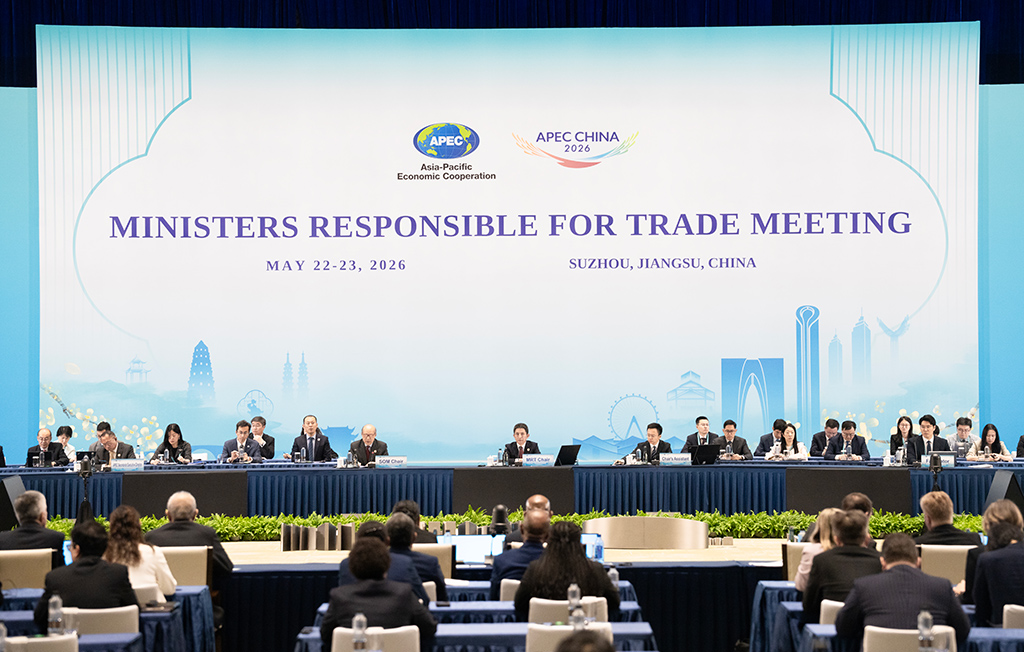
1. We, the Asia-Pacific Economic Cooperation (APEC) Ministers Responsible for Trade (MRT), met in Suzhou, People’s Republic of China, on 22-23 May 2026, under the chairmanship of H.E. Wang Wentao, Minister of Commerce of the People’s Republic of China. We welcome the participation of the Director-General of the World Trade Organization (WTO), the Acting Secretary-General of the United Nations Conference on Trade and Development (UNCTAD), the APEC Business Advisory Council (ABAC), the Association of Southeast Asian Nations (ASEAN) and the Pacific Economic Cooperation Council (PECC). We express our appreciation to the city of Suzhou and Jiangsu Province for the exceptional hospitality extended for this meeting.
2. Over the past few decades, APEC has spearheaded the region’s contribution to global economic growth. Today, technological development and industrial transformation are advancing rapidly, emerging as important engines of economic growth. At the same time, global trade continues to face significant challenges. Against this backdrop, we remain committed to APEC as the premier forum for regional economic cooperation and emphasize the importance of its role in bringing us together to address economic challenges and create a more resilient and prosperous Asia-Pacific region for all.
3. We remain committed to the Putrajaya Vision 2040, including through the implementation of the Aotearoa Plan of Action to build an open, dynamic, resilient, and peaceful Asia-Pacific community for the prosperity of all our people and future generations. Inspired by the APEC 2026 theme of "Building an Asia-Pacific Community to Prosper Together", we discussed trade and investment under China’s APEC priorities “Openness, Innovation, Cooperation”.
Advancing Regional and Global Trade
4. We reaffirm our shared commitment to advancing economic integration in the Asia-Pacific region in a manner that is market-driven, including through the work on the Free Trade Area of the Asia-Pacific (FTAAP) agenda. APEC can play a role in building economies’ capacity to participate in high standard and comprehensive undertakings. We will continue working together to enhance experience sharing, capacity building, business engagement and technical cooperation among members, including through the Capacity Building Needs Initiative (CBNI). As identified in the Ichma Statement, we support efforts to promote high standards and increase areas of convergence in trade agreements, including through important and meaningful conversations on state-owned enterprises, trade and labor, trade and environment, trade digitalization, digital trade, trade facilitation, MSMEs and competition policy, to improve the trade and investment environment for our businesses and people.
5. In the face of supply chains challenges impacting on our region, we reaffirm our commitment to maintain resilient supply chains, particularly to essential goods, such as energy products and critical downstream derivatives. We recognize that it is in our mutual interest that our region remains interconnected and trade corridors remain open, to facilitate trade flows, including energy supplies and other essential goods. We affirm our resolve to work together and with other trade partners to ensure trade continues to flow and critical infrastructure continues to support the viability and integrity of supply chains globally.
6. We support efforts to address supply chains issues within APEC to enhance the resilience of supply chains for sustainable economic growth and strengthen global and regional value chains. We recognize the importance of transparency with respect to measures that may affect trade or disrupt supply chains. We welcome the contributions of the Third Phase of Supply Chain Connectivity Framework Action Plan (SCFAP III, 2022-2026) to address supply chain chokepoints in the region, especially in promoting digital transformation of trade procedures and transition towards paperless trade. We instruct officials to complete the final review of SCFAP III by November this year. We encourage greater engagement of the private sector in APEC’s supply chain discussions, including through public-private dialogues. We recognize the collaborative role of existing platforms in APEC that promote supply chain connectivity and trade facilitation.
7. We recognize the critical role that trade can play in achieving food security, minimizing food supply chain disruptions, and promoting open, fair, transparent, productive, resilient, and innovative agri-food systems that benefit all. In this regard, we remain committed to advancing concrete actions to strengthen food security and enhance the resilience of agri-food systems across the APEC region, including through practical cooperation, recognizing existing APEC frameworks.
8. We recognize the contribution of connectivity in promoting the prosperity of our region, and note work done in this regard. This includes the APEC Connectivity Blueprint (2015-2025), which was aimed at strengthening physical, institutional and people-to-people connectivity in the APEC region. Building on previous efforts, we encourage members to further advance connectivity cooperation, taking into account the findings and recommendations from the ACB's final review. Recognizing the importance of business exchanges in enhancing regional trade and investment, we welcome APEC’s efforts in facilitating business mobility and enhancing connectivity through the APEC Business Travel Card (ABTC), and encourage fully participating economies’ uptake and acceptance of the virtual ABTC. We reaffirm the importance of quality infrastructure development and investment. We also welcome continued efforts on enhancing connectivity in regional, sub-regional and remote areas.
9. We reiterate the importance of substantive reforms and cooperative initiatives to achieve an open and predictable environment for innovative, competitive and resilient services sectors. To further advance this objective, we support continued work by participating members on the APEC Services Index to identify barriers to services trade by integrating digital trade into the APEC Services Index. In this regard, we welcome the APEC Roadmap for Innovative, Competitive and Resilient Services (Annex), which is intended to identify and reduce barriers to services trade, drive economic growth, and fuel job creation. We support work to reduce unnecessary barriers and facilitate digital services.
10. We note the progress on the implementation work of APEC Investment Facilitation Action Plan, and encourage investment facilitation capacity building programs for APEC economies.
11. We encourage efforts to strengthen cooperation on standards and conformity assessment procedures to reduce unnecessary technical barriers to trade across APEC economies. We reaffirm the value of implementing good regulatory practices (GRPs) to foster transparency, predictability and efficiency in the regulatory environment in the APEC region, including by drawing on the GRP Blueprint as a useful guide. We encourage deepened exchange and cooperation on technical standards in sectors of mutual interest.
12. Recognizing the important contributions of micro, small and medium-sized enterprises (MSMEs) and all people to economic growth, we commit to support their participation in regional and global markets by providing information tools and enhancing access to skills development. We welcome prior and ongoing efforts to foster MSME advancement, including efforts to promote the transition from the informal economy to the formal economy. We recognize the economic empowerment of all, including women, as an important way to boost productivity and innovation and discussed APEC’s efforts to date to advance women’s full, effective and meaningful participation and leadership in the economy, trade and global value chains, including through existing APEC initiatives. We will continue to promote greater access to capital, assets, markets and skills training for all, including through capacity building initiatives for all who seek access to economic and trade opportunities. We acknowledge the valuable contribution of Indigenous Peoples, as appropriate, to economic growth and welcome further dialogues and collaborative efforts focused on capacity building to increase their participation in regional and global markets.
13. We are committed to strengthening the protection and the enforcement of intellectual property rights (IPR), including through promoting intellectual property rights in advancing innovation and creativity through relevant policies and programs, as well as continued efforts to address challenges faced by innovators, creators, and brand owners.
14. We acknowledge the agreed upon rules in the WTO are key to facilitating global trade. The impasse at the 14th WTO Ministerial Conference (MC14) again underscored that the WTO has challenges and needs meaningful reform to improve all its functions, and to be more relevant and responsive to the interest of its Members. We encourage Members to work together to improve the WTO. Further, we welcome efforts to deepen discussions on addressing those challenges including contemporary trade issues, and intend to work collaboratively, through APEC’s role as an incubator of ideas, to support Members’ deliberations at the WTO.
15. We welcome the acceptance by 17 APEC economies of the WTO Agreement on Fisheries Subsidies and call on the remaining economies to complete their domestic procedures, and encourage all WTO Members to conclude negotiations on additional disciplines as soon as possible. We recognize the need for constructive engagement on agriculture at the WTO. We support a moratorium on customs duties on electronic transmissions which helps keep digital markets open and predictable, and note the efforts by some economies to reach an agreement for a permanent moratorium of customs duties on electronic transmissions.
16. We recognize the positive role that plurilateral negotiations at the WTO, including the Joint Statement Initiatives (JSIs), are playing in advancing issues of interest to Members, and in addressing contemporary trade issues, fostering new ideas, facilitating economic growth, and building momentum toward multilateral outcomes. We note the efforts of participating Members of the WTO JSIs to incorporate the Investment Facilitation for Development (IFD) Agreement and WTO Agreement on Electronic Commerce (ECA) into the WTO legal framework. We also note the efforts by economies to participate in and implement the JSI on Services Domestic Regulation.
Foster New Engines of Innovative and Dynamic Trade and Investment Cooperation
17. We affirm our commitment to growing the digital economy and to ensuring that the benefits of digital transformation are accessible to all, including by bridging digital divides, and broadening and enhancing digital connectivity. We look forward to the continued implementation of the APEC Internet and Digital Economy Roadmap (AIDER) in a way that addresses emerging opportunities and challenges in the rapidly evolving digital landscape. We encourage economies to strengthen affordable and resilient digital infrastructure, promote capacity building, accelerate interoperability, address online harms, and enhance digital literacy and skills to facilitate digital transformation. Recognizing the increasing importance of data to the digital economy, we will continue our cooperation on facilitating the flow of data across borders, and strengthening business and consumer trust in digital transactions, in addition to ensuring data protection and privacy.
18. We recognize the important role of digitalization as a driver for innovation, productivity, and economic growth across the region, and its benefit to enhancing and facilitating trade. We reaffirm our commitment to facilitating paperless trade in the region, by promoting the cross-border recognition of electronic trade-related documents, including the electronic bills of lading and electronic invoices, and through capacity-building efforts. We welcome the substantial progress towards developing a framework for cooperation on trade digitalization in order to foster an enabling ecosystem for trade digitalization. We encourage economies to ensure that the adoption of new technologies for trade digitalization is made in a considered and deliberate manner, and call on APEC to develop policy recommendations for government decision-making on trade digitalization. We encourage further engagement between the public and private sectors to advance paperless trade in the region, including through the APEC Centre of Excellence for Paperless Trade (ACCEPT). We encourage APEC economies to work towards aligning our legal frameworks with the principles of the UNCITRAL Model Law on Electronic Transferable Records (MLETR), noting the different levels of readiness and capacity, and other relevant international conventions on the use of electronic signatures and electronic authentication.
19. Recalling the APEC AI Initiative and recognizing the potential of AI to reshape international trade, we are committed to harnessing AI’s benefits for trade and expanding AI-related trade in goods and services in our region. We also call for continued efforts to enhance security, accessibility, trustworthiness and reliability in realizing the benefits of AI for all, including fostering the adoption of AI in international trade and regional ICT ecosystem development, with a focus on information exchange, cooperation and capacity building. We look forward to continued discussions on AI during APEC 2026 Digital Weeks.
20. We acknowledge the importance of strengthening supply chain efficiency, security, and resilience through the use of AI and technological innovations. We welcome APEC’s work on digitalizing customs procedures and modernizing customs processes. We welcome voluntary experience sharing in APEC on trade-related AI standards and technologies that takes into account and complements the work of appropriate specialized international organizations, processes and other efforts. We encourage economies to continue to discuss trade rules in the context of the growing role of AI. We also encourage economies to share domestic approaches to relevant AI-related policy with the private sector, including MSMEs, to help businesses identify opportunities and risks as well as improve competitiveness.
21. We recognize the growing importance of cross‑border e‑commerce for international trade and facilitation of MSMEs’ participation and integration into global value chains. We commend APEC’s work on customs administration, consumer protection and business upskilling and support the effective implementation of initiatives in this area including the APEC Non-Binding Guidelines for Customs & Cross-Border E-Commerce. We welcome capacity building activities to bridge digital divides, and support MSME’s participation in digital platforms and the global digital economy.
22. We recognize that building resilience to the impacts of environmental and related challenges goes hand-in-hand with technological innovation and has the potential to unlock significant economic opportunities. In this regard, we recognize APEC’s past and ongoing work to foster cooperation in advancing resilient business models. We underscore the importance of ex-ante investment in adaptation and disaster risk reduction. We affirm the importance of science- and risk-based approaches and avoiding one-size-fits-all measures. We support continued work on environmental services. We encourage APEC economies to consider how capacity building and exchanges of experience can help meet their respective environmental and trade objectives.
23. We emphasize the importance of efforts to address illegal, unreported, and unregulated (IUU) fishing and illegal logging and associated trade (ILAT), including through sharing information and best practices, in order to strengthen legitimate trade in these sectors.
24. We express our appreciation to the People’s Republic of China for hosting this meeting and look forward to meeting in Shenzhen in November and our continued collaboration throughout 2026.