

Hangzhou, People's Republic of China
•25 August 2026
Joint Statement on the 11th APEC Food Security Ministerial Meeting Hangzhou
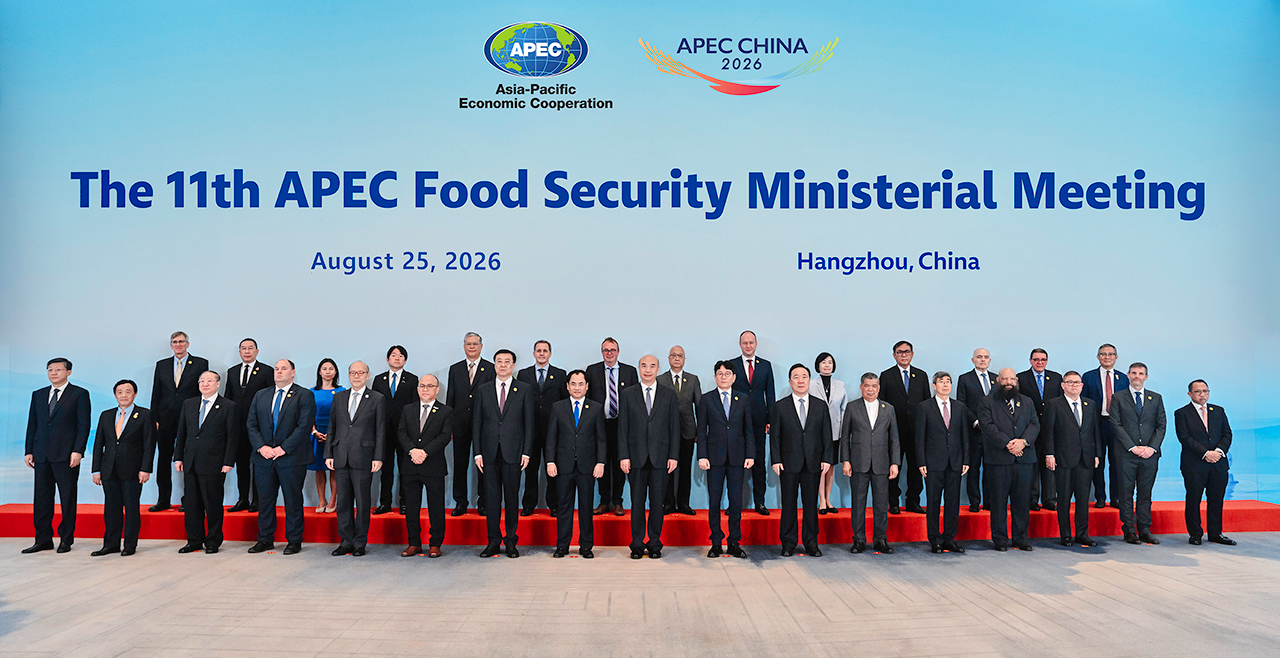
Joint Statement on the 11th APEC Food Security Ministerial Meeting
Hangzhou, People’s Republic of China, 25 August 2026
1. We, the Asia-Pacific Economic Cooperation (APEC) Ministers responsible for food security, attended the 11th APEC Food Security Ministerial Meeting held in Hangzhou, China on 25 August 2026 chaired by H.E. Zhang Zhu, Minister of Agriculture and Rural Affairs of the People’s Republic of China. We welcomed the participation of the APEC Business Advisory Council (ABAC), the Food and Agriculture Organization of the United Nations (FAO), and the World Food Programme (WFP).
2. We reaffirm our aspiration to build an open, dynamic, resilient and peaceful Asia-Pacific community for the prosperity of all our people and future generations, as reflected in the APEC Putrajaya Vision 2040. Under the 2026 APEC theme of “Building an Asia-Pacific Community to Prosper Together”, and guided by existing APEC frameworks, and the work of the Policy Partnership on Food Security and other relevant working groups and fora, we will continue to promote cooperation among APEC member economies to advance regional food security and nutrition.
3. Global food security remains a shared priority. As a central hub of global food production and consumption, the Asia-Pacific region makes a significant contribution to global food security and continues to advance innovation and cooperation across agri-food systems. While the region has shown resilience in the face of recent challenges, it continues to face pressures including extreme weather events and natural hazards, supply chain disruptions, and persistently high levels of food loss and waste (FLW). Further efforts are needed to improve food security for all people. In light of these opportunities and challenges, we recognize the need to accelerate the innovation-led transformation of and investment, as appropriate, in agri-food systems and encourage all economies to continue advancing cooperation in food security, with a view to achieving higher quality food, improved productivity, greater efficiency and stronger resilience.
4. We recognize innovation as a central driver of agri-food systems transformation and food security. We welcome the Principles for Strengthening Food Systems Resilience in the APEC Region through Innovation and Digitalization and support science- and evidence-based, technology-enabled agriculture, including utilizing tools such as artificial intelligence (AI) and promoting advances in agricultural biotechnology. We underscore the importance of sustained investment in agricultural research and development (R&D), along with the adoption of advanced practices that are locally appropriate, farmer led and systems based, to boost productivity, improve resource use efficiency and enhance resilience. We encourage collaboration among public and private sectors, agricultural research institutions, and farmers to support the wider dissemination and uptake of innovation and support regional cooperation on voluntary and mutually agreed terms to strengthen agri-food systems across the APEC region.
5. We reaffirm that preventing and reducing food loss and waste (FLW) is an important means of strengthening food security and improving resource use efficiency. We encourage economies to advance relevant APEC principles and action plans, strengthen food value chains, and support technical exchange, capacity building, and evidence-based approaches, including improved data, monitoring and public-private collaboration. We also encourage the adoption, as appropriate, of innovation, technology, and improved management practices to reduce FLW across production, post-harvest handling, storage, processing, logistics, retail and consumption. These efforts can support more resilient and efficient agri-food systems, and contribute to improved access to safe, nutritious and affordable food.
6. We emphasize the importance of effective natural resource management including forests, water, and land, in underpinning long-term food security. Recognizing the close linkages among agri-food systems, ecosystems, and economic growth, we support practical, science- and evidence-based agricultural approaches that improve productivity while maintaining and improving soil health, water resources, and biodiversity, recognizing there is no “one-size-fits-all” approach. We support strengthening cooperation, as appropriate, to help farmers anticipate, manage and recover from shocks and changing conditions, including through adaptive agricultural practices, better use of data, tools and risk management approaches. To this end, we encourage economies to promote approaches that enhance productivity, profitability, efficiency, and resilience, benefitting everyone.
7. We recognize the key role of fisheries and aquaculture in supporting food security, providing high-quality nutrition, creating jobs for regional communities, and increasing supply of fish and aquatic products domestically, regionally and internationally. We support strengthening cooperation on fisheries management, combating Illegal, Unreported, and Unregulated (IUU) fishing activities, advancing marine ecosystem protection and restoration, improving responsible fisheries governance systems, voluntary sharing of best practices and information on fisheries and aquaculture technologies on mutually agreed terms, promoting effective and science-based management of fishery resources, fostering the resilient development of coastal areas as well as enhancing aquatic product quality.
8. Trade facilitation serves as an important pillar underpinning food security and market resilience. We recognize the critical role that trade can play in achieving food security, minimizing food supply chain disruptions, and promoting open, fair, transparent, productive, resilient, and innovative agri-food systems that benefit all. We remain committed to advancing concrete actions to strengthen food security and enhance the resilience of agri-food systems across the APEC region. We recognize the importance of transparency with respect to measures that may affect trade or disrupt supply chains. We encourage cooperation in areas such as digitalization, technical services, logistics, supply chain management, and implementing science- and risk-based standards, including for animal and plant diseases prevention and control, as appropriate, to support agri-food trade in the region.
9. We acknowledge that agricultural investment helps to create new market and development opportunities, improves the efficiency and resilience of regional value chains, promotes economic growth and helps strengthen the competitiveness of agri-food sectors. We encourage APEC economies to promote policies that strengthen agricultural investment and encourage cooperation across the Asia-Pacific region, as appropriate, to foster more resilient and dynamic agri-food systems.
10. Food production, processing, distribution, and consumption can be important drivers of rural development, economic opportunity and thriving rural and regional communities with everyone's participation. We acknowledge the role of technology for rural development and encourage voluntary access to innovation and digital technologies on mutually agreed terms through entrepreneurship and digital transformation while promoting participation at all levels of decision making in food systems. We encourage collaboration among stakeholders to enhance training and capacity-building programs through public-private cooperation.
11. We reaffirm our commitment to strengthening rural development as a foundation for food security and agricultural resilience. We encourage economies, as appropriate, to strengthen rural infrastructure, promote agri-food sector development and improve public services in rural areas, recognizing that this can help increase farmer incomes, improve livelihoods, and contribute to economic growth.
12. We recognize the role of relevant APEC fora and working groups—such as PPFS, the Oceans and Fisheries Working Group (OFWG), the Agricultural Technical Cooperation Working Group (ATCWG), the APEC High Level Policy Dialogue on Agricultural Biotechnology (HLPDAB) and others—in facilitating collaboration on food security issues. We support the private sector’s role in PPFS to share their valuable expertise, practical insights, and useful advice on how we may work together to address food security challenges. This includes sharing best practices and identifying topics for collaborative work.
13. We express our sincere appreciation to the People’s Republic of China for hosting this successful and fruitful Ministerial Meeting on Food Security. We look forward to the 12th APEC Ministerial Meeting on Food Security to be held in 2027 in Viet Nam.