Proceedings
APEC Workshop on Higher Education in Standardization
The Asia-Pacific Economic Cooperation (APEC) is a regional economic forum established in 1989 to leverage the growing interdependence of the Asia-Pacific.
The Asia-Pacific Economic Cooperation (APEC) is a regional economic forum established in 1989 to leverage the growing interdependence of the Asia-Pacific.
APEC ensures that goods, services, investment and people move easily across borders. Members facilitate this trade through faster customs procedures at borders; more favorable business climates behind the border; and aligning regulations and standards across the region.
APEC ensures that goods, services, investment and people move easily across borders. Members facilitate this trade through faster customs procedures at borders; more favorable business climates behind the border; and aligning regulations and standards across the region.
APEC has helped drive economic growth and cooperation across the Asia-Pacific by reducing trade barriers, improving the ease of doing business and strengthening connectivity among economies. These efforts have contributed to rising incomes, expanded trade and greater opportunities for businesses and communities across the region.
APEC has helped drive economic growth and cooperation across the Asia-Pacific by reducing trade barriers, improving the ease of doing business and strengthening connectivity among economies. These efforts have contributed to rising incomes, expanded trade and greater opportunities for businesses and communities across the region.
APEC brings together governments, businesses and stakeholders to collaborate on shared priorities. Explore opportunities to participate in events, contribute to initiatives and engage with APEC’s work across the region.
APEC brings together governments, businesses and stakeholders to collaborate on shared priorities. Explore opportunities to participate in events, contribute to initiatives and engage with APEC’s work across the region.
Reports
•August 2019
Download Report
5MB
Published Under
APEC Secretariat, APEC Policy Support Unit
Accessed
9739
Pages
84
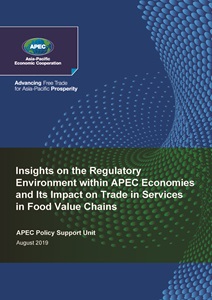
Services are a critical component of the food system. They support different stages of the food value chain and facilitate smooth functioning of the entire system to deliver food worldwide. This study begins by looking at the role of services in the food value chain, before shifting its attention to three key services found in such value chain, namely: financial, logistics and distribution. The role of ICT in food value chains is also examined.
The study points out that the improvement of regulatory environment affecting the provision of services in the food value chain requires a “whole-of-government” approach effort, as the formulation of services-related regulations usually entails the participation of several agencies. There is also no “one-size-fits-all” solution. It offers a few suggestions that could be beneficial for food value chains, such as adoption of international standards and best practices in regulatory issues affecting the food industry and services sectors associated to it; upgrading of existing or building of new infrastructure; and the use of technology and modern ICT services.