Manuals
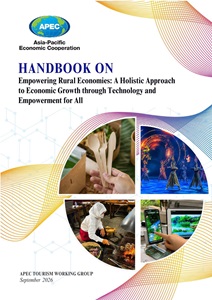
Empowering Rural Economies: A Holistic Approach to Economic Growth through Technology and Empowerment for All
The Asia-Pacific Economic Cooperation (APEC) is a regional economic forum established in 1989 to leverage the growing interdependence of the Asia-Pacific.
The Asia-Pacific Economic Cooperation (APEC) is a regional economic forum established in 1989 to leverage the growing interdependence of the Asia-Pacific.
APEC ensures that goods, services, investment and people move easily across borders. Members facilitate this trade through faster customs procedures at borders; more favorable business climates behind the border; and aligning regulations and standards across the region.
APEC ensures that goods, services, investment and people move easily across borders. Members facilitate this trade through faster customs procedures at borders; more favorable business climates behind the border; and aligning regulations and standards across the region.
APEC has helped drive economic growth and cooperation across the Asia-Pacific by reducing trade barriers, improving the ease of doing business and strengthening connectivity among economies. These efforts have contributed to rising incomes, expanded trade and greater opportunities for businesses and communities across the region.
APEC has helped drive economic growth and cooperation across the Asia-Pacific by reducing trade barriers, improving the ease of doing business and strengthening connectivity among economies. These efforts have contributed to rising incomes, expanded trade and greater opportunities for businesses and communities across the region.
APEC brings together governments, businesses and stakeholders to collaborate on shared priorities. Explore opportunities to participate in events, contribute to initiatives and engage with APEC’s work across the region.
APEC brings together governments, businesses and stakeholders to collaborate on shared priorities. Explore opportunities to participate in events, contribute to initiatives and engage with APEC’s work across the region.
Reports
•April 2019
Download Report
11MB
Published Under
Economic Committee (EC)
Accessed
4770
This publication aims to evaluate the quality of the Ex Post evaluation of regulations by verifying the content of the three main sections of the Ex Post RIA and provide a final recommendation about the future status of the regulation submitted to an ex-post evaluation analysis.
The Traffic Light Score Methodology (TLSM) seeks to become part of the good regulatory practices inside APEC that contribute to the following impacts in the region: an oversight tool to verify if the regulations are delivering the intended impacts and measuring the real costs and benefits; a systematic feedback on the robustness of the assumptions used in the Ex-Ante RIA, which allows regulators to make adjustments, if necessary, to current regulation; a diagnostic tool to identify and seize improvements on public policies, instead of reacting to external reviews and appraisals.