Reports
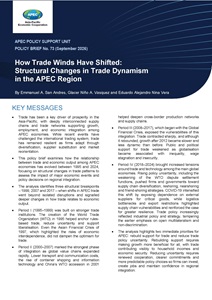
How Trade Winds Have Shifted: Structural Changes in Trade Dynamism in the APEC Region
The Asia-Pacific Economic Cooperation (APEC) is a regional economic forum established in 1989 to leverage the growing interdependence of the Asia-Pacific.
The Asia-Pacific Economic Cooperation (APEC) is a regional economic forum established in 1989 to leverage the growing interdependence of the Asia-Pacific.
APEC ensures that goods, services, investment and people move easily across borders. Members facilitate this trade through faster customs procedures at borders; more favorable business climates behind the border; and aligning regulations and standards across the region.
APEC ensures that goods, services, investment and people move easily across borders. Members facilitate this trade through faster customs procedures at borders; more favorable business climates behind the border; and aligning regulations and standards across the region.
APEC has helped drive economic growth and cooperation across the Asia-Pacific by reducing trade barriers, improving the ease of doing business and strengthening connectivity among economies. These efforts have contributed to rising incomes, expanded trade and greater opportunities for businesses and communities across the region.
APEC has helped drive economic growth and cooperation across the Asia-Pacific by reducing trade barriers, improving the ease of doing business and strengthening connectivity among economies. These efforts have contributed to rising incomes, expanded trade and greater opportunities for businesses and communities across the region.
APEC brings together governments, businesses and stakeholders to collaborate on shared priorities. Explore opportunities to participate in events, contribute to initiatives and engage with APEC’s work across the region.
APEC brings together governments, businesses and stakeholders to collaborate on shared priorities. Explore opportunities to participate in events, contribute to initiatives and engage with APEC’s work across the region.
Reports
•November 2009
Download Report
4MB
Published Under
Other APEC Groups and Initiatives, Members Selected Publications, Finance Ministers' Process (FMP)
Accessed
35884
Pages
57
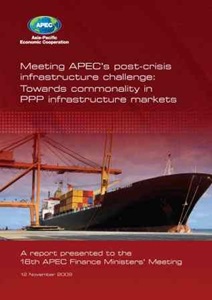
The purpose of this report is to recommend tools to enhance effective delivery of infrastructure projects
in APEC member economies by identifying areas of commonality, where further and more detailed
harmonisation of approaches may be appropriate.
Current practices of procurement in a range of member economies have been reviewed to determine
key areas of commonality and ‘best practice’ that already exist within individual economies, as well as
areas where further consistency of approach would be beneficial.
Whilst, in economies with more developed PPP markets, the approach to procurement is broadly
similar, other economies with newly developing markets can clearly benefit from the experiences of
those with more developed markets. APEC could play a role in framing a set of ‘best practice’ principles
around the key elements of the procurement process. These principles would undoubtedly provide
both governments and the private sector with greater confidence in the process, and deliver
benefits through increased competition.
1. Introduction
2. Recommendations for commonality
3. Harmonisation of the foundations of PPP procurement
4. Harmonisation of project development
5. Harmonisation of the procurement process
6. Next steps