

Reports
Advancing Economic Development in the APEC Region: Best Practices for Smart Human–Machine Collaboration in the Heavy Steel Construction Industry
The Asia-Pacific Economic Cooperation (APEC) is a regional economic forum established in 1989 to leverage the growing interdependence of the Asia-Pacific.
The Asia-Pacific Economic Cooperation (APEC) is a regional economic forum established in 1989 to leverage the growing interdependence of the Asia-Pacific.
APEC ensures that goods, services, investment and people move easily across borders. Members facilitate this trade through faster customs procedures at borders; more favorable business climates behind the border; and aligning regulations and standards across the region.
APEC ensures that goods, services, investment and people move easily across borders. Members facilitate this trade through faster customs procedures at borders; more favorable business climates behind the border; and aligning regulations and standards across the region.
APEC has helped drive economic growth and cooperation across the Asia-Pacific by reducing trade barriers, improving the ease of doing business and strengthening connectivity among economies. These efforts have contributed to rising incomes, expanded trade and greater opportunities for businesses and communities across the region.
APEC has helped drive economic growth and cooperation across the Asia-Pacific by reducing trade barriers, improving the ease of doing business and strengthening connectivity among economies. These efforts have contributed to rising incomes, expanded trade and greater opportunities for businesses and communities across the region.
APEC brings together governments, businesses and stakeholders to collaborate on shared priorities. Explore opportunities to participate in events, contribute to initiatives and engage with APEC’s work across the region.
APEC brings together governments, businesses and stakeholders to collaborate on shared priorities. Explore opportunities to participate in events, contribute to initiatives and engage with APEC’s work across the region.
Reports
•November 2021
Download Report
7MB
Published Under
APEC Secretariat, APEC Policy Support Unit
Accessed
4119
Pages
44
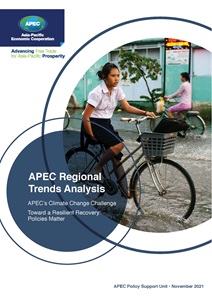
Climate change is an existential threat not only for the APEC region, but for humanity as a whole. The theme chapter discusses how APEC is severely affected by climate change, but also how the region disproportionately contributes to it in terms of greenhouse gas (GHG) emissions. While APEC economies have made some achievements with respect to their sustainable economic growth targets, the region needs to significantly do more—including setting more ambitious reductions in GHG emissions—to ensure a habitable and affluent Asia-Pacific in the next century.
The next chapter on economic and trade trends shows the rebound of the APEC region’s economy as it learns to live with COVID-19. APEC GDP grew by 8.0 percent in the first half of 2021, while trading activity saw double-digit growth during the same period. The APEC region is expected to grow by 6.0 percent in 2021, before settling at 3.2 percent in the medium-term, with the anticipated winding down of fiscal and monetary support measures. Substantial uncertainty surrounds the growth projections, with the Delta variant and virus mutations posing as the biggest threat to economic recovery. The unequal access to vaccines needs to be addressed to avoid a two-track recovery, with some able to revive economic activity at a faster and more durable pace while other economies continue to grapple with resurgent infections amid tighter fiscal conditions.
Reports
Advancing Economic Development in the APEC Region: Best Practices for Smart Human–Machine Collaboration in the Heavy Steel Construction Industry
Proceedings
APEC Workshop on Shaping Digital Transformation in Accreditation
Manuals
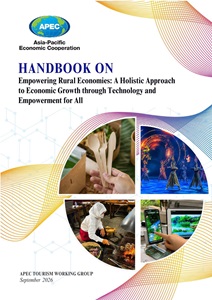
Empowering Rural Economies: A Holistic Approach to Economic Growth through Technology and Empowerment for All